Self-guided audio tour in Jerusalem
Start Free on iPhone
Start free on iPhone to unlock this self-guided walking tour in Jerusalem. Hear all the stories that make it amazing, walk at your own pace, and begin whenever you want.
Your Private Tour Guide
Jerusalem is a city of stone and story, where every block of limestone has witnessed millennia of transformation. This self-guided walk invites you to explore the formidable fortifications that define the Old City, tracing the perimeter of the world-famous ramparts. Built primarily in the 16th century by the Ottoman Sultan Suleiman the Magnificent, these walls were designed to protect the holy sites within while projecting the power of an empire. On this walking route, you will discover that the gates are more than mere entrances; they are transition points between distinct cultures and eras. Starting at the Zion Gate, you will see the physical scars of modern conflict before moving toward the Tower of David, a citadel that has served as a fortress for Hasmoneans, Romans, Crusaders, and Ottomans alike. As you navigate this historic path, you will encounter the bustling Jaffa Gate, the primary artery for travelers entering from the coast, and the ornate Damascus Gate, widely considered the most beautiful example of Ottoman architecture in the region. The route also leads you to the Western Wall, the most sacred site in Judaism, where the ancient stones of the Second Temple complex still stand as a testament to spiritual endurance. Ending at the Dung Gate, you will have traversed the edges of the Armenian, Christian, Muslim, and Jewish Quarters. This self-guided adventure offers the flexibility to linger at archaeological sites or pause for a coffee in a hidden courtyard. By following this walking route Jerusalem reveals its layers at your own pace, allowing you to appreciate the architectural mastery and the heavy weight of history that permeates the 'Golden City.' Whether you are a first-time visitor or a returning history enthusiast, exploring these ramparts independently provides a profound connection to the survival of one of the world's oldest continuously inhabited cities.
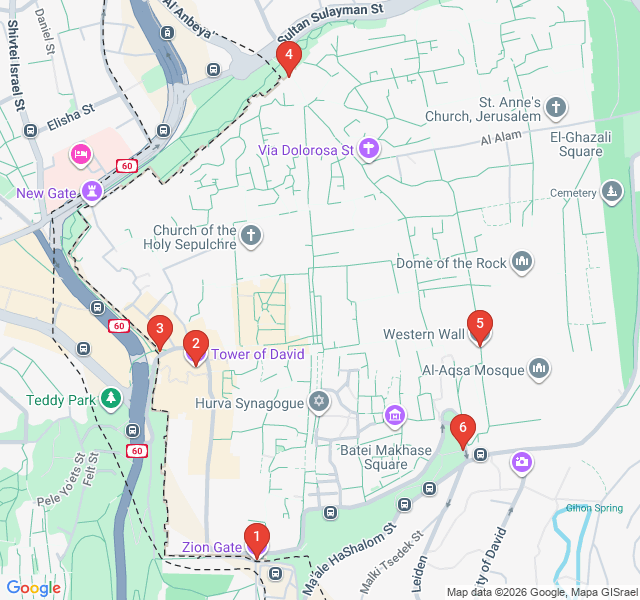
Numbers indicate the order of stops on the tour.
Welcome to Zion Gate, also known as Bab al-Nabi Daud. As you stand before this entrance to the Armenian Quarter, look closely at the exterior stones. You will notice thousands of pockmarks—these are bullet holes from the heavy fighting that occurred here during the 1948 Arab-Israeli War. The gate was a critical strategic point for the Palmach forces attempting to reach the besieged Jewish Quarter. Built in 1540 by Suleiman the Magnificent, the gate features a classic 'L-shaped' entrance, a common medieval defensive design intended to slow down charging enemies and prevent them from using battering rams effectively. It serves as a somber reminder of how ancient defenses continue to play a role in modern history.
Dominating the skyline near Jaffa Gate is the Tower of David, though the name is a bit of a historical misnomer. This massive citadel was actually built over centuries by various conquerors, including King Herod the Great, who erected three massive towers here to protect his palace. The current structure largely dates to the Mamluk and Ottoman periods. Despite its name, it has no direct link to the biblical King David; Byzantine Christians mistakenly identified the tallest Herodian tower as part of David's palace. Today, the citadel stands as a magnificent museum of Jerusalem's history, showcasing archaeological finds from the First Temple period through the Crusades. The view from its ramparts offers one of the best 360-degree vistas of the Old and New City.
Jaffa Gate is the most famous of the Old City's entrances, named because it faces west toward the ancient port of Jaffa. Notice the wide gap in the wall immediately to the right of the gate tower. This was not part of the original Ottoman design; it was created in 1898 to allow the carriage of German Emperor Kaiser Wilhelm II to enter the city with pomp and ceremony. Historically, this gate was the end of the road for pilgrims arriving by sea. Inside the gate, you will find the meeting point of the Christian and Armenian Quarters. Look for the two small tombs just inside the gate, rumored to belong to the two architects Suleiman the Magnificent allegedly executed for failing to include Mount Zion within the city walls.
Widely regarded as the most ornate and impressive of the eight gates, Damascus Gate (Bab al-Amud) is the main entrance to the Muslim Quarter. The current gate was built in 1537, but if you look below the current street level to the left, you can see the remains of a Roman triumphal arch dating back to the 2nd century AD, built by Emperor Hadrian. The gate is a focal point of local life, usually bustling with vendors selling fresh produce and pastries. Its architectural details, including the decorative battlements and the soaring archway, reflect the peak of Ottoman aesthetic influence in Jerusalem. It has historically been the starting point for the road leading north to Nablus and Damascus.
The Western Wall, or Kotel, is not actually a gate or a wall of a building, but a retaining wall for the massive platform of the Temple Mount. Built by Herod the Great over 2,000 years ago, these enormous limestone blocks supported the Second Temple. Following the temple's destruction by the Romans in 70 AD, this section became the closest accessible point to the Holy of Holies, making it the most sacred site for Jewish prayer. Observe the massive 'Master Course' stones, some weighing hundreds of tons, which were placed without mortar. The atmosphere here is one of deep devotion, as visitors from around the world tuck written prayers into the crevices between the ancient stones.
Our final stop is the Dung Gate, the southernmost entrance to the Old City. Its unusual name appears in the Book of Nehemiah and likely refers to the gate's historical function as the exit through which the city's refuse was carried out to the Kidron Valley. In the mid-20th century, the gate was significantly widened by Jordanian and later Israeli authorities to allow vehicles to reach the Western Wall area. From here, you are perfectly positioned to see the excavations of the City of David and the Southern Wall. This gate serves as the primary link between the holy sites of the Old City and the archaeological heart of ancient Jerusalem located just outside the walls.
Start Free on iPhone
Explore “The Golden City: Old City Gates & Ramparts” with your very own Private Tour Guide with Zigway. Start free on iPhone, skip the large group and the fixed routes, and hear the city come alive as you go.
Your Private Tour Guide
Don't miss the good stuff
Explore Freely
 Easy
EasyJerusalem, Israel
Taste the heart of Jerusalem on this self-guided walk through the legendary stalls and hidden gems of Mahane Yehuda Market.
 Easy
EasyJerusalem, Israel
Explore the secluded world of Mea Shearim on this self-guided walk through Jerusalem’s historic ultra-Orthodox district and 19th-century courtyards.
 Easy
EasyJerusalem, Israel
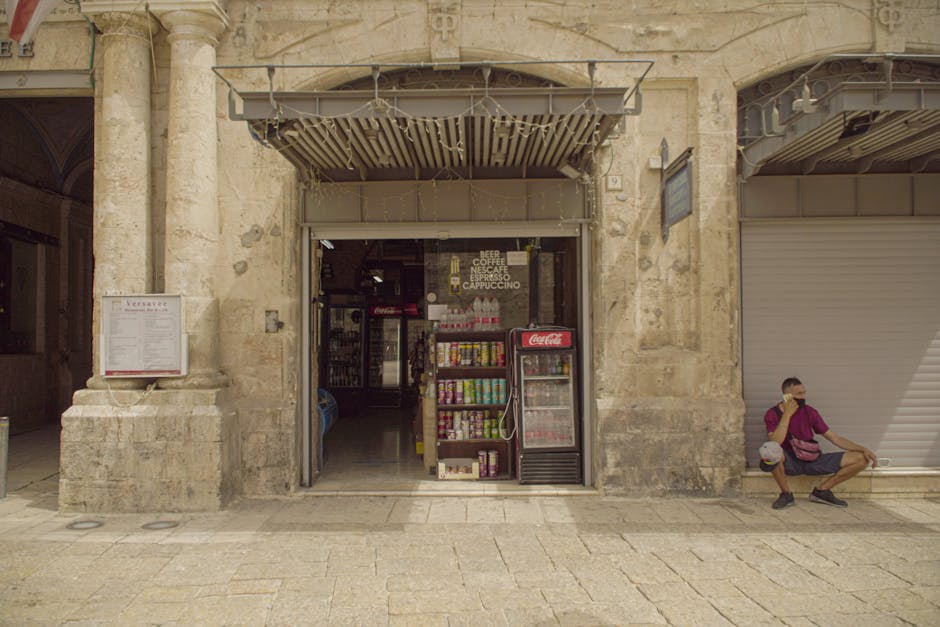
Explore Jerusalem's nightlife and street art, from the shutter murals of the Shuk to secret speakeasies and creative hubs in the City Center.
 Easy
EasyJerusalem, Israel
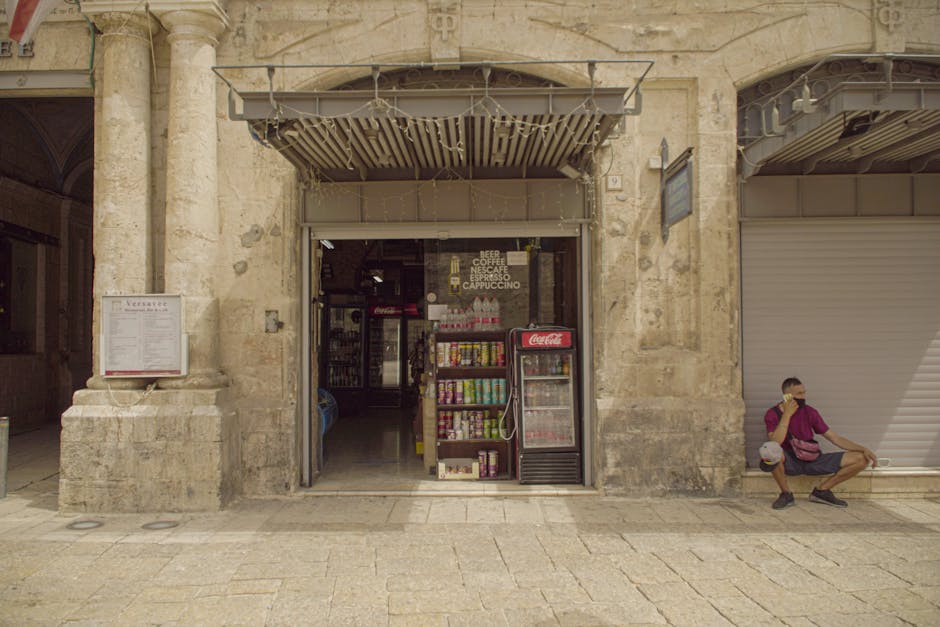
Explore the 'Garden Suburb' of Jerusalem's elite. Discover Bauhaus architecture, historic residences of prime ministers, and intellectual landmarks.
 Easy
EasyNairobi, Kenya
Explore Nairobi's architectural evolution from colonial-era landmarks to iconic Brutalist skyscrapers on this historic self-guided walking route.
 Easy
EasyNairobi, Kenya
Discover Nairobi's iconic skyline on this self-guided architecture walk through the CBD’s most famous modernist and Brutalist landmarks.
 Moderate
Vienna, Austria
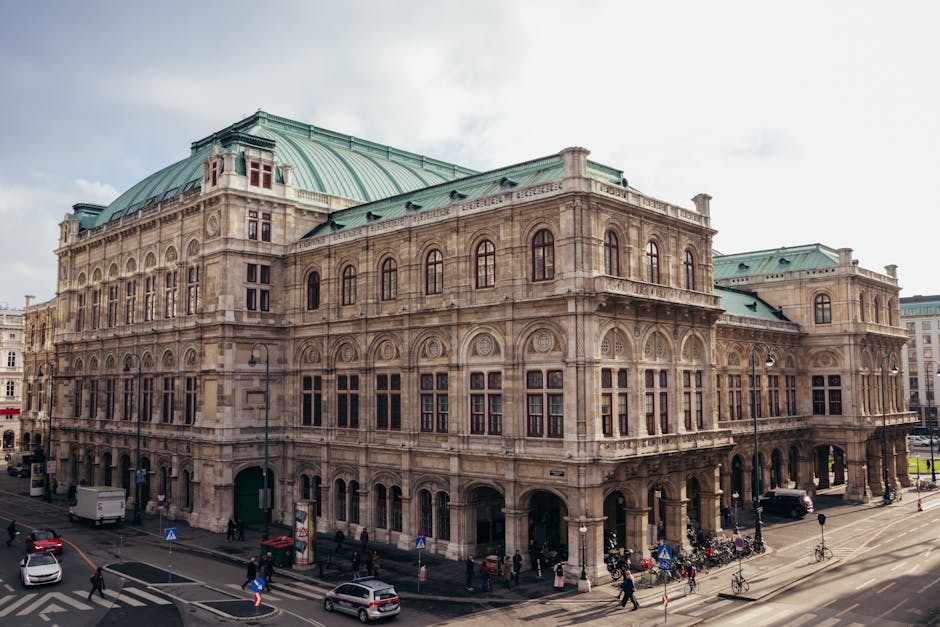
Follow the footsteps of Mozart and Strauss through Vienna’s historic center on this self-guided walk through the city's rich musical history.
 Easy
EasySalzburg, Austria
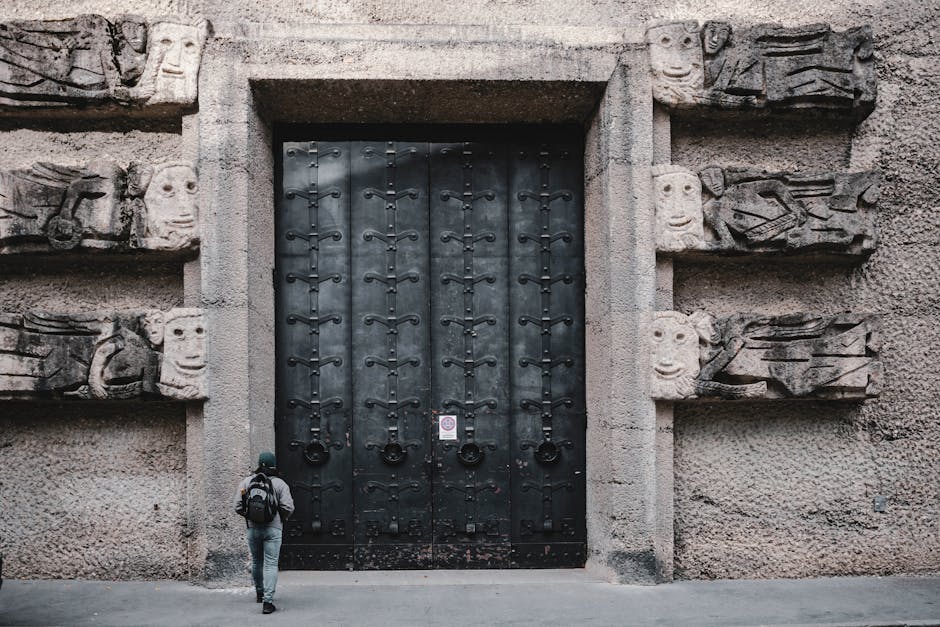
Discover the 'Rome of the North' on this self-guided walk through the Baroque squares and monumental legacy of Salzburg’s Prince-Archbishops.
 Easy
EasyTel Aviv, Israel
Explore a hidden New England-style village in Tel Aviv. Discover wooden houses and 19th-century history on this peaceful self-guided walk.
 Easy
EasyTel Aviv, Israel
Explore the literary heart and stunning architecture of Tel Aviv's most beautiful historic street on this self-guided neighborhood stroll.
 Easy
EasyTel Aviv, Israel
Experience the sea breeze on this self-guided walk through Tel Aviv's historic port, featuring iconic boardwalks, markets, and sunset views.
 Easy
EasyTel Aviv, Israel
Explore the birthplace of Tel Aviv on a self-guided adventure through Bauhaus architecture and the historic site of Israel's independence.