Self-guided audio tour in Nairobi
Start Free on iPhone
Start free on iPhone to unlock this self-guided walking tour in Nairobi. Hear all the stories that make it amazing, walk at your own pace, and begin whenever you want.
Your Private Tour Guide
Step into the heart of Kenya's capital with this self-guided walking route through the Nairobi Central Business District. Nairobi, often called the 'Green City in the Sun,' is a fascinating blend of rapid modernization and preserved colonial history. This neighborhood stroll invites you to witness the architectural evolution of the city, from the early 20th-century stone structures of the British Protectorate to the towering Brutalist icons that defined the post-independence era. As you explore independently, you will see how the skyline serves as a timeline of Kenya’s journey from a railway depot to a global hub for commerce and diplomacy. Your journey begins at the Kenyatta International Convention Centre (KICC), a masterpiece of African modernism that remains the most recognizable feature of the city's horizon. From here, the route winds past the halls of financial power and into the storied corridors of the Sarova Stanley, where literary giants once gathered. You will discover the neoclassical elegance of the McMillan Memorial Library and the intricate beauty of the Jamia Mosque, highlighting the city's diverse cultural and religious fabric. This walking tour Nairobi experience concludes at Kipande House, a building that stands as a stark reminder of the colonial administrative systems of the past. This walking route is designed for those who want to uncover the stories behind the stone and glass at their own pace. Whether you are interested in the political history of East Africa or the unique architectural styles that emerged during the mid-century, this audio walk provides a deep dive into the soul of the city. Away from the frantic pace of modern traffic, you can pause to admire the craftsmanship of early pioneers and the bold visions of independence-era architects. Discover the layers of Nairobi’s identity on this immersive self-guided adventure through its most historic streets.
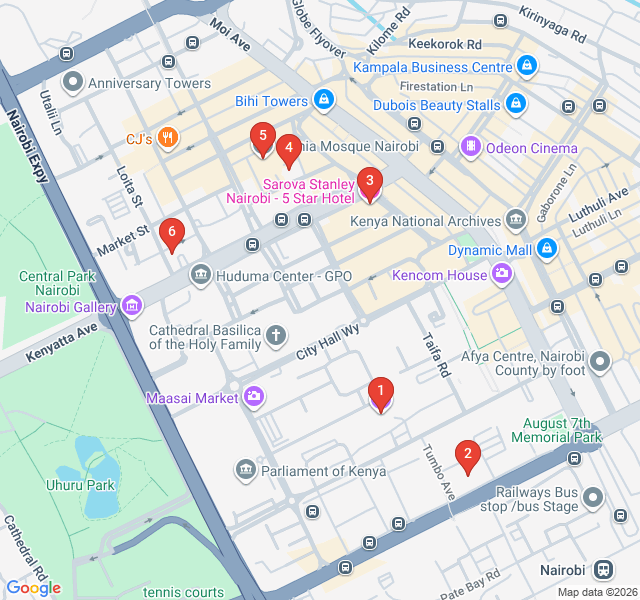
Numbers indicate the order of stops on the tour.
Welcome to the starting point of your self-guided walk. The KICC is more than just a building; it is a symbol of Kenya’s sovereignty. Commissioned by Kenya's first president, Jomo Kenyatta, and completed in 1973, it was designed by David Mutiso and Karl Henrik Nøstvik. The architecture is a unique blend of international modernism and African inspiration, with the main tower resembling a terracotta-colored lily and the plenary hall mimicking a traditional African hut. For decades, this was the tallest building in the city. Its presence on the skyline signaled Nairobi's arrival as a major player in international diplomacy and commerce. Take a moment to admire the geometric patterns and the sprawling City Square that surrounds it.
As you move toward the financial heart of the city, you encounter the Central Bank of Kenya Headquarters. This structure represents the shift toward Brutalist architecture that dominated government buildings in the 1960s and 70s. The heavy, functional concrete design was intended to project strength and stability for the newly independent nation's economy. The bank was established in 1966 shortly after Kenya moved away from the East African Shilling to its own national currency. While the exterior may seem austere, it represents the vital transition from a colonial economy to a self-determined financial system. It remains the anchor of Nairobi's 'Wall Street' area.
Step back in time as you approach the Sarova Stanley. Opened in 1902, this is Nairobi’s first luxury hotel and has hosted everyone from Ernest Hemingway to Princess Elizabeth. In the early days of the British Protectorate, it was the social epicenter for explorers and settlers. Look for the famous 'Thorn Tree Cafe' on the ground floor. In the era before modern telecommunications, travelers would pin notes to the trunk of a thorn tree in the center of the cafe to communicate with friends and family. Although the tree has been replaced over the generations, the tradition remains a legendary part of Nairobi's social history. The hotel’s Victorian-meets-colonial aesthetic is a rare survivor in this fast-changing city.
Guardians of stone lions greet you at the entrance of the McMillan Memorial Library. This neoclassical gem was built in 1931 by Lady Lucy McMillan in memory of her husband, Sir Northrup McMillan. It is the oldest library in Nairobi and was originally intended as a whites-only institution during the colonial era, a restriction that was finally lifted in the early 1960s. Inside, the high ceilings and marble columns house a vast collection of East Africana and rare manuscripts. The building's design, with its grand portico and towering pillars, feels like a piece of London transported to the equator, serving as a reminder of the architectural ambitions of the British empire in Kenya.
The striking silver domes and twin minarets of the Jamia Mosque represent the deep roots of the Muslim community in Nairobi. Built between 1902 and 1906, and later extended, the mosque is a masterpiece of Arabic-Islamic architecture. It serves as a spiritual hub for the city's significant population of citizens with heritage from the coast and South Asia. The intricate tile work and the serene atmosphere provide a sharp contrast to the bustling commercial streets just outside its gates. The mosque has played a vital role in the social and political life of Nairobi, often serving as a center for community organization and charity throughout the city's history.
Your walk concludes at Kipande House, one of the most historically significant buildings in the CBD. Built in 1913, its name comes from the Swahili word 'Kipande,' referring to the identification documents that African workers were forced to wear around their necks in small metal boxes during the colonial period. This building served as the central registration office where these documents were issued and tracked. Architecturally, it is famous for its tall, slender tower, which made it the tallest building in Nairobi until the mid-1930s. Today, it houses a commercial bank, but its facade remains a poignant reminder of the complexities of Kenya's colonial past and the struggle for dignity and independence.
Start Free on iPhone
Explore “Nairobi's Colonial Echoes and Skyline” with your very own Private Tour Guide with Zigway. Start free on iPhone, skip the large group and the fixed routes, and hear the city come alive as you go.
Your Private Tour Guide
Don't miss the good stuff
Explore Freely
 Moderate
Nairobi, Kenya
Discover the creative soul of Nairobi on this self-guided walk through the city's premier art galleries, markets, and artisan workshops.
 Moderate
Nairobi, Kenya
Taste your way through Nairobi's Westlands on this self-guided walk featuring street snacks, cultural landmarks, and hidden foodie gems.
 Easy
EasyNairobi, Kenya
Explore the history of Kenya’s independence through the statues, monuments, and parks that define Nairobi’s political heart on this self-guided walk.
 Easy
EasyNairobi, Kenya
Discover Nairobi's iconic skyline on this self-guided architecture walk through the CBD’s most famous modernist and Brutalist landmarks.
 Easy
EasySalzburg, Austria
Discover the 'Rome of the North' on this self-guided walk through the Baroque squares and monumental legacy of Salzburg’s Prince-Archbishops.
 Easy
EasyGothenburg, Sweden
Discover Gothenburg’s 17th-century Dutch foundations, historic canals, and military fortifications on this self-guided architectural walk.
 Easy
EasyKrakow, Poland
Explore the prestigious Jagiellonian University district, featuring Neo-Gothic architecture, Baroque churches, and Krakow's hidden scholarly gems.
 Easy
EasyKrakow, Poland
Explore the historic heart of Kazimierz on this self-guided walk through synagogues, ancient cemeteries, and vibrant squares.