Self-guided audio tour in Jerusalem
Start Free on iPhone
Start free on iPhone to unlock this self-guided walking tour in Jerusalem. Hear all the stories that make it amazing, walk at your own pace, and begin whenever you want.
Your Private Tour Guide
Jerusalem’s Old City is a dense tapestry of human history, where every limestone block has witnessed centuries of prayer, conflict, and coexistence. This self-guided walking route, 'Stones of Faith,' invites you to peel back the layers of the Armenian, Jewish, Christian, and Muslim Quarters at your own pace. While a traditional walking tour Jerusalem offers can be rigid, this independent journey allows you to linger in the incense-filled halls of ancient cathedrals or pause for a Viennese coffee in a 19th-century hospice. You will begin in the quiet, walled-off serenity of the Armenian Quarter, exploring the St. James Cathedral, a site that feels frozen in the medieval era. From there, the path transitions into the Jewish Quarter, where the Hurva Synagogue stands as a symbol of resilience, having been destroyed and rebuilt multiple times. You will walk the Cardo, the Roman Empire’s main thoroughfare, where modern shops now sit between 1,500-year-old pillars. The spiritual heart of the walk lies at the Church of the Holy Sepulchre, a complex architectural marvel shared by six Christian denominations. As you move into the Muslim Quarter, the atmosphere shifts to the vibrant energy of the Suq. A visit to the Austrian Hospice provides a surprising European oasis with one of the best rooftop views of the Dome of the Rock. Finally, you will descend into the Mamluk-era Suq El Qatanin, the Cotton Merchants' Market, which leads directly toward the Temple Mount. This walking route is designed for those who want to understand Jerusalem's complexity without being rushed. By choosing this self-guided adventure, you gain the freedom to explore the hidden corners that a standard walking tour Jerusalem visitor might miss, discovering the city's soul through its enduring stones.
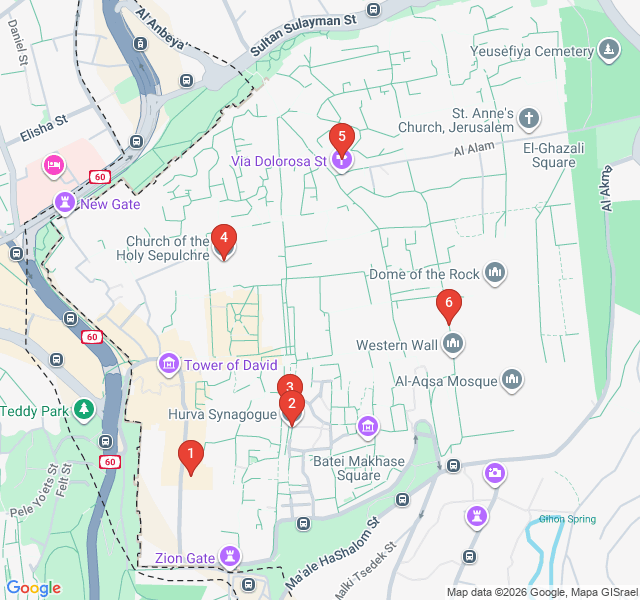
Numbers indicate the order of stops on the tour.
Welcome to the Armenian Quarter, the smallest and quietest of the four sections of the Old City. The Cathedral of St. James is the heart of this community, dating back to the 12th century. As you enter, notice the hundreds of oil lamps hanging from the ceiling and the intricate blue Kutahya tiles. This church is dedicated to two saints named James: James the Greater, one of the apostles, and James the Just, the brother of Jesus. The atmosphere here is thick with history and the scent of incense. Armenians have been a presence in Jerusalem since the 4th century, and this cathedral serves as a fortress-like sanctuary that has protected their culture for generations. Note that the church is usually only open to the public during daily services.
Moving into the Jewish Quarter, you encounter the Hurva Synagogue, whose name literally means 'The Ruin.' For centuries, this site was a shell of a building, destroyed by various conquerors and left in shambles. Its current form, completed in 2010, is a faithful reconstruction of the 19th-century building that was destroyed during the 1948 Arab-Israeli War. The massive white dome is a landmark visible from all over the city. Inside, the design is breathtaking, featuring a towering holy ark and murals depicting Jewish holy sites. It stands as a powerful symbol of the Jewish people’s return to the Old City and the persistence of faith through cycles of destruction and rebirth.
Step back in time as you walk along the Cardo, which was the main north-south 'heart' of Jerusalem during the Roman and Byzantine periods. Excavated after 1967, this street was once lined with a colonnade of massive pillars and covered walkways to protect shoppers from the sun. Look for the reproduction of the Madaba Map, a 6th-century mosaic found in Jordan that shows Jerusalem as it appeared during the Byzantine era. Today, the Cardo is a unique blend of archaeology and commerce; you can see 1,500-year-old flagstones directly adjacent to modern art galleries and souvenir shops. It is a perfect example of how Jerusalem lives within its own history, layering the present directly on top of the past.
You are now at the most sacred site in Christendom. This massive, sprawling complex encompasses the locations identified as Golgotha, where Jesus was crucified, and the empty tomb where he was buried and resurrected. The church is a fascinating, often confusing mix of architectural styles, from Romanesque to Byzantine. It is uniquely shared by six different Christian denominations—Greek Orthodox, Roman Catholic, Armenian, Coptic, Ethiopian, and Syrian Orthodox. Because of their historical rivalries, the 'Status Quo' agreement strictly governs every inch of the building. Look up at the 'Immovable Ladder' above the entrance, which hasn't been moved since the 18th century because no one can agree on who owns the window it leans against.
As you enter the Muslim Quarter via the Via Dolorosa, the Austrian Hospice offers a sudden change of pace. Founded in 1854 as a pilgrim house for the Austro-Hungarian Empire, it feels like stepping directly into Vienna. The hallways are decorated with portraits of Emperor Franz Joseph, and the cafe serves authentic Sachertorte and apple strudel. While the coffee is excellent, the real treasure is the rooftop. Head upstairs for one of the most spectacular 360-degree views of the Old City. From here, you can see the Dome of the Rock, the Holy Sepulchre, and the Mount of Olives all in one frame, illustrating the incredible religious density of this square kilometer.
Our final stop is the Suq El Qatanin, or the Cotton Merchants' Market. This is one of the finest examples of Mamluk architecture in Jerusalem, built in the 14th century. The market is a long, vaulted tunnel characterized by its alternating red and white stone patterns, known as ablaq. Historically, this was a wealthy trading hub for textiles. Today, it leads directly to the 'Gate of the Cotton Merchants,' one of the entrances to the Haram al-Sharif (Temple Mount). While non-Muslims cannot enter the Temple Mount through this gate, the market itself is a beautiful, atmospheric place to witness the daily life of the Muslim Quarter and admire the enduring medieval craftsmanship of the city.
Start Free on iPhone
Explore “Stones of Faith: The Four Quarters Exploration” with your very own Private Tour Guide with Zigway. Start free on iPhone, skip the large group and the fixed routes, and hear the city come alive as you go.
Your Private Tour Guide
Don't miss the good stuff
Explore Freely
 Easy
EasyJerusalem, Israel
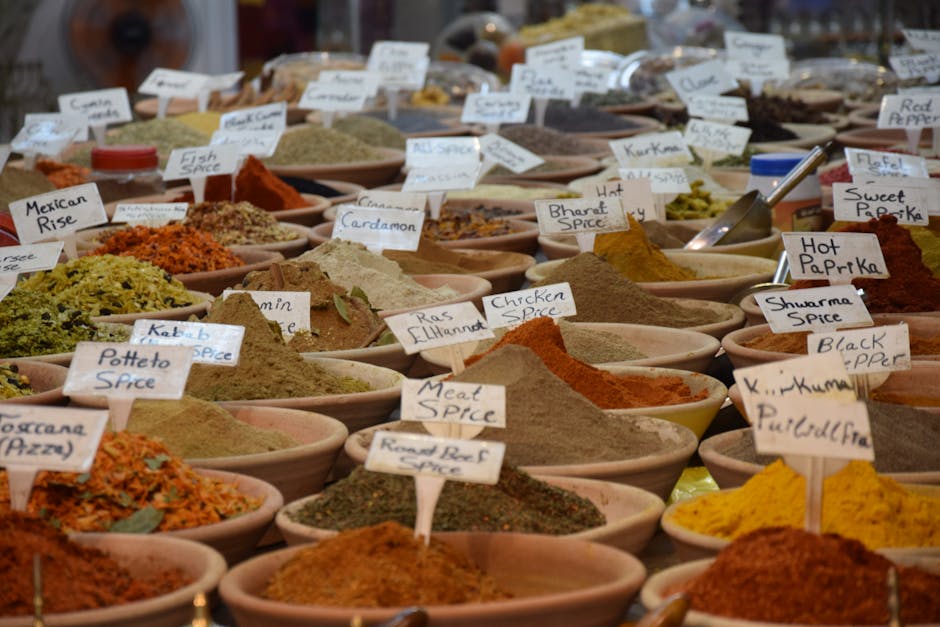
Taste the heart of Jerusalem on this self-guided walk through the legendary stalls and hidden gems of Mahane Yehuda Market.
 Easy
EasyJerusalem, Israel
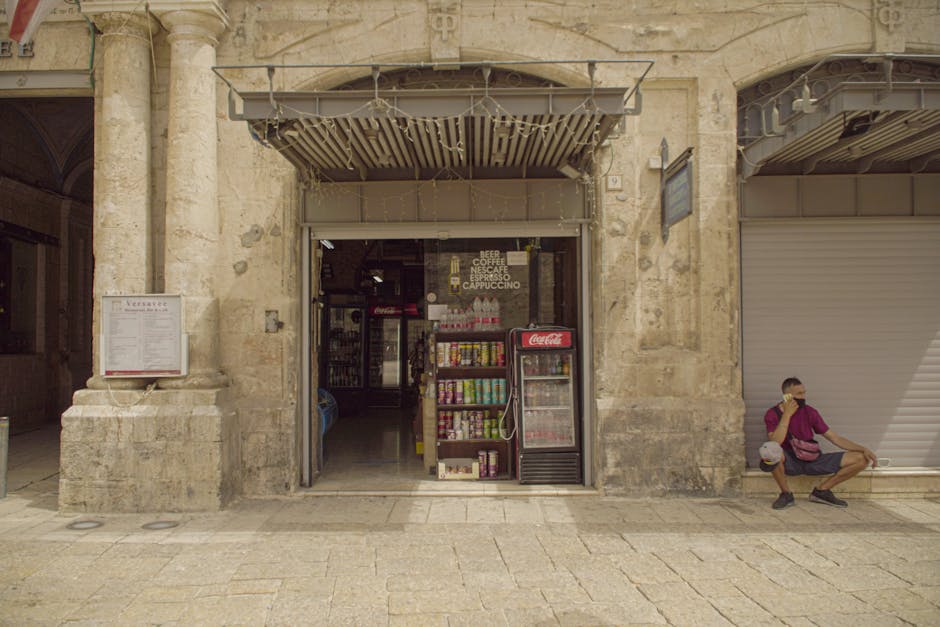
Explore the secluded world of Mea Shearim on this self-guided walk through Jerusalem’s historic ultra-Orthodox district and 19th-century courtyards.
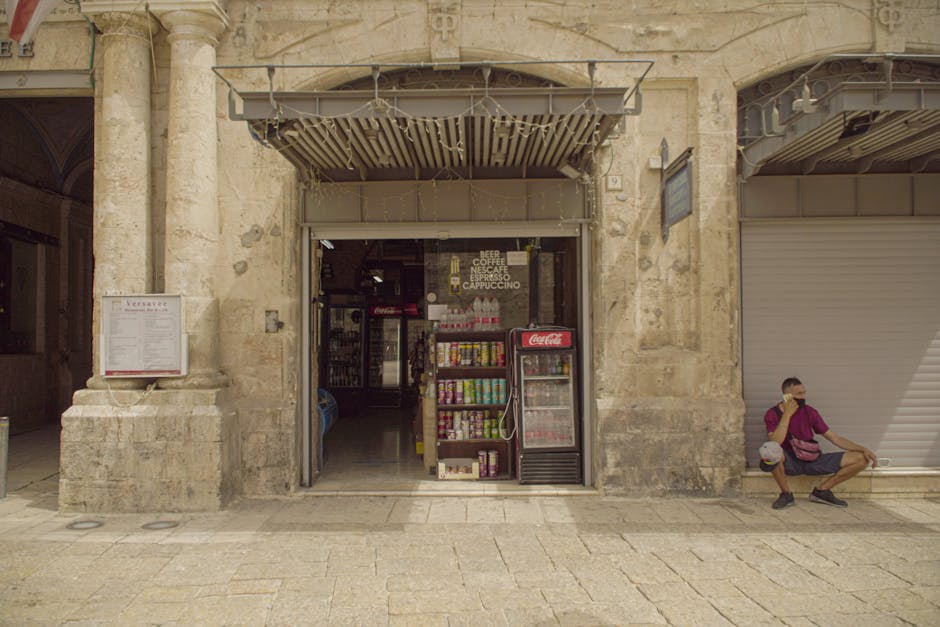 Easy
EasyJerusalem, Israel
Explore Jerusalem's nightlife and street art, from the shutter murals of the Shuk to secret speakeasies and creative hubs in the City Center.
 Easy
EasyJerusalem, Israel
Explore the 'Garden Suburb' of Jerusalem's elite. Discover Bauhaus architecture, historic residences of prime ministers, and intellectual landmarks.
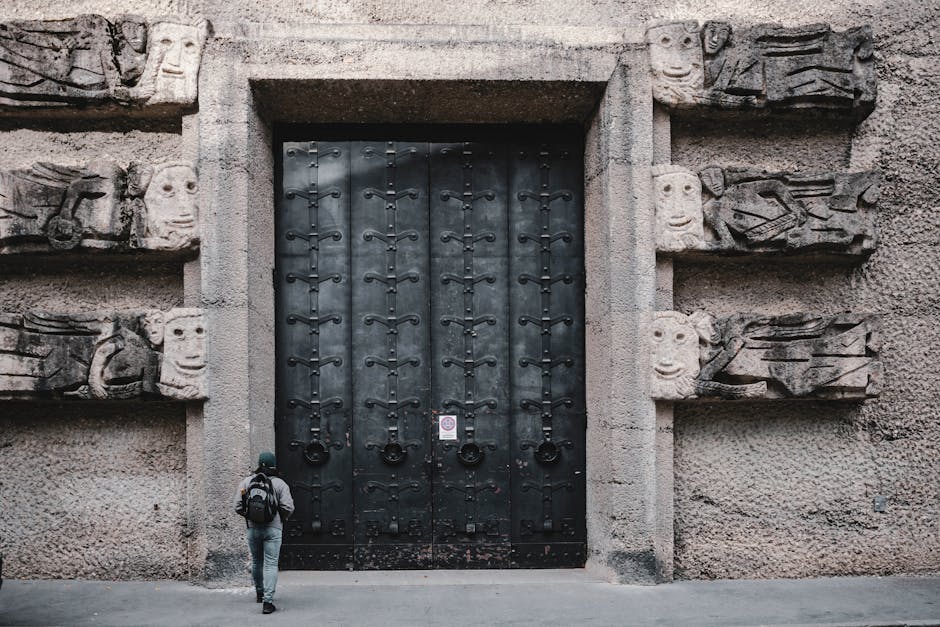 Easy
EasySalzburg, Austria
Discover the 'Rome of the North' on this self-guided walk through the Baroque squares and monumental legacy of Salzburg’s Prince-Archbishops.
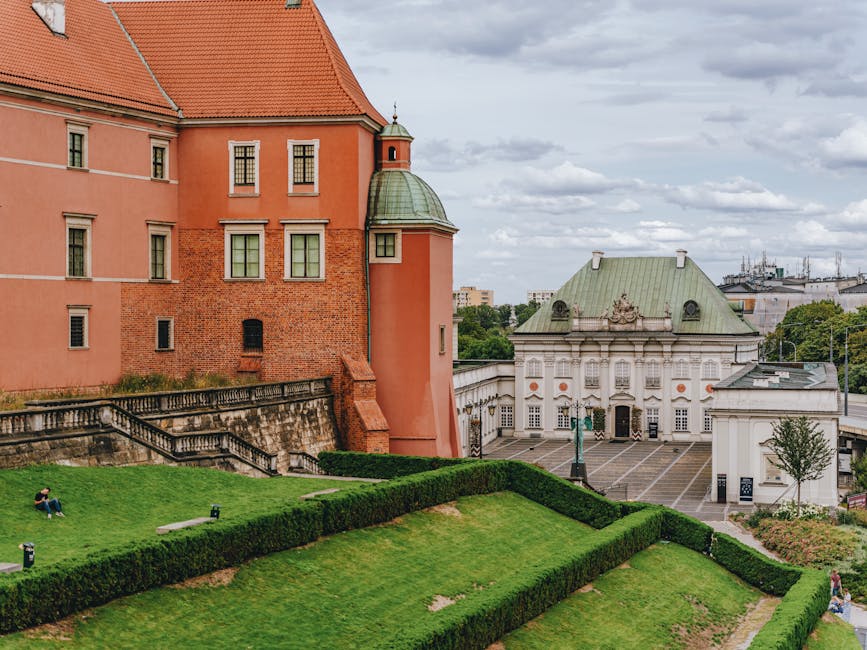 Moderate
Warsaw, Poland
Explore the resilient spirit of Warsaw's Muranów district on this self-guided walk through the history and landmarks of the former Jewish Ghetto.
 Moderate
Vienna, Austria
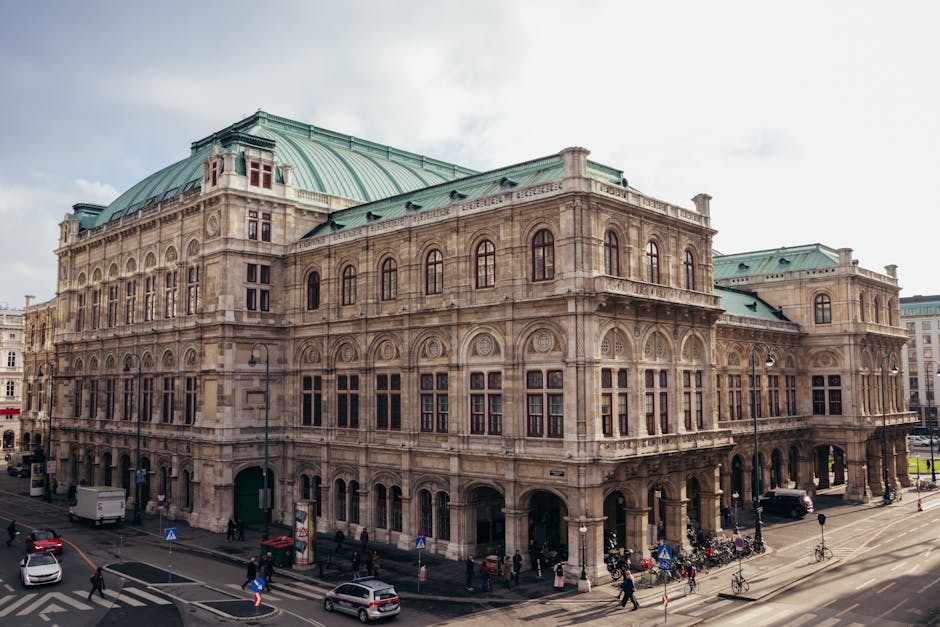
Follow the footsteps of Mozart and Strauss through Vienna’s historic center on this self-guided walk through the city's rich musical history.
 Easy
EasyKrakow, Poland
Explore the historic heart of Kazimierz on this self-guided walk through synagogues, ancient cemeteries, and vibrant squares.
 Easy
EasyTel Aviv, Israel
Explore a hidden New England-style village in Tel Aviv. Discover wooden houses and 19th-century history on this peaceful self-guided walk.
 Easy
EasyTel Aviv, Israel
Explore the literary heart and stunning architecture of Tel Aviv's most beautiful historic street on this self-guided neighborhood stroll.
 Easy
EasyTel Aviv, Israel
Experience the sea breeze on this self-guided walk through Tel Aviv's historic port, featuring iconic boardwalks, markets, and sunset views.
 Easy
EasyTel Aviv, Israel
Explore the birthplace of Tel Aviv on a self-guided adventure through Bauhaus architecture and the historic site of Israel's independence.