Self-guided audio tour in Cape Town
Start Free on iPhone
Start free on iPhone to unlock this self-guided walking tour in Cape Town. Hear all the stories that make it amazing, walk at your own pace, and begin whenever you want.
Your Private Tour Guide
Step back into the 17th century with this self-guided walking route through the historic heart of Cape Town, focusing on the military and maritime legacy of the Dutch East India Company (VOC). Known as the "Tavern of the Seas," Cape Town began as a tiny supply station for ships traveling between Europe and the East Indies. This neighborhood stroll takes you through the City Bowl, where the layers of Dutch, British, and modern South African history are stacked upon one another in stone and bronze. Your journey begins at the majestic Cape Town City Hall, an Edwardian masterpiece that stands as a transition point between the colonial era and the birth of a new democracy. Here, you will encounter the Nelson Mandela Statue, which marks the exact balcony where the world-renowned leader delivered his first speech upon release from prison in 1990. As you explore independently, you will cross the Grand Parade, the city's oldest public square. This vast open space was once a military drill ground for the VOC and is now a vibrant marketplace. It serves as the gateway to the primary highlight of this audio walk: the Castle of Good Hope. This five-pointed star fortress is the oldest surviving colonial-era building in South Africa. Its thick stone walls and five bastions—each with its own name and history—were designed to protect the Dutch colony from rival maritime powers. Walking through its gates, you are transported to an era of global trade, naval warfare, and early settlement. This walking tour Cape Town experience provides deep insights into the architectural ingenuity and military fortifications of the Dutch East India Company while connecting those historical threads to the liberation struggle of the 20th century. Whether you are a military history buff, an architecture enthusiast, or a first-time visitor, this route offers a concise yet comprehensive look at the foundations of the Mother City. The path is flat and easy to navigate, making it a perfect morning or afternoon activity for those who want to discover Cape Town's origins at their own pace.
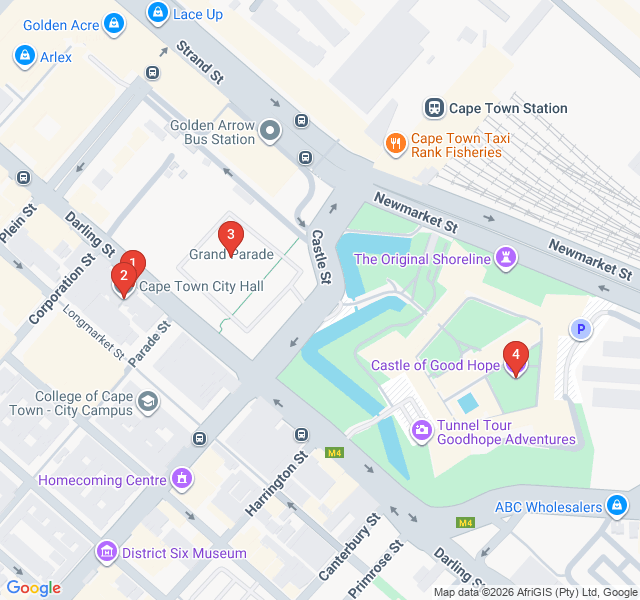
Numbers indicate the order of stops on the tour.
Standing on the balcony of the City Hall, the bronze statue of Nelson Mandela captures a pivotal moment in global history. This life-sized tribute marks the exact spot where Mandela stood on February 11, 1990, just hours after his release from Victor Verster Prison. After 27 years of incarceration, he delivered a speech that called for peace, reconciliation, and the continued struggle for a non-racial South Africa. The statue, unveiled in 2018, depicts "Madiba" with his fist raised in a power salute, smiling down at the Grand Parade where a massive crowd once roared in celebration. It serves as a powerful reminder of the transition from the colonial and apartheid past—represented by the surrounding fortifications and administrative buildings—to a future defined by democratic freedom and human rights.
Cape Town City Hall is a magnificent example of Edwardian architecture, completed in 1905. Constructed using honey-colored limestone imported from Bath, England, the building reflects the grandeur of the British colonial era. Its design is Italian Renaissance in style, featuring ornate carvings, marble floors, and a grand organ. The most striking feature is the clock tower, which stands nearly 60 meters high and contains a carillon of 39 bells. Interestingly, the clock is a half-scale replica of Big Ben in London. While the building no longer serves as the primary seat of city government, it remains a vital cultural venue, hosting concerts by the Cape Town Philharmonic Orchestra. The balcony overlooking the Grand Parade is particularly famous as the spot where Nelson Mandela addressed the world following his liberation.
The Grand Parade is Cape Town's oldest public space, a vast square that has witnessed the city's transformation from a maritime replenishment station to a modern democratic hub. In the early days of the Dutch settlement, this area was used as a military parade ground and a site for public gatherings. It was here that the first fort, the Fort de Goede Hoop, was located before the current stone castle was built. Over the centuries, the Parade became a bustling marketplace, a role it still fulfills today with its rows of colorful stalls selling everything from textiles to traditional snacks like "koesisters." Its most historic moment occurred in 1990, when tens of thousands gathered here to hear Nelson Mandela speak for the first time after his release from prison, marking the beginning of the end for the apartheid era.
The Castle of Good Hope is the architectural crown jewel of the Dutch East India Company's (VOC) presence in Africa. Constructed between 1666 and 1679, this pentagonal fortress replaced an earlier clay and timber fort. Its five bastions—Leerdam, Buuren, Katzenellenbogen, Nassau, and Oranje—were named after the titles of the Prince of Orange. This site served as the seat of military and government authority for over two centuries. As you stand before the main entrance, notice the bell tower, which houses a bell cast in Amsterdam in 1697. The castle was never actually attacked from the sea, but its presence was a powerful deterrent to rival European powers. Today, it stands as a complex symbol of colonial history and a repository of military heritage, housing the Castle Military Museum and the William Fehr Collection.
Start Free on iPhone
Explore “The Five-Pointed Star: Fortifications of the Dutch East India Company” with your very own Private Tour Guide with Zigway. Start free on iPhone, skip the large group and the fixed routes, and hear the city come alive as you go.
Your Private Tour Guide
Don't miss the good stuff
Explore Freely
 Moderate
Cape Town, South Africa
Explore the vibrant murals and creative hubs of Woodstock on this self-guided neighborhood stroll through Cape Town's artistic heart.
 Easy
EasyCape Town, South Africa
Explore the evolution of Cape Town’s harbor from its 18th-century roots to a modern cultural hub on this self-guided maritime history walk.
 Easy
EasyCape Town, South Africa
Discover the heritage of Cape Town on this self-guided audio walk through the historic Company’s Garden and its surrounding landmarks.
 Easy
EasyCape Town, South Africa
Explore Cape Town's bohemian heart and scientific heritage on this self-guided walk through the eclectic and historic Observatory neighborhood.
 Easy
EasyNairobi, Kenya
Explore Nairobi's architectural evolution from colonial-era landmarks to iconic Brutalist skyscrapers on this historic self-guided walking route.
 Easy
EasyNairobi, Kenya
Discover Nairobi's iconic skyline on this self-guided architecture walk through the CBD’s most famous modernist and Brutalist landmarks.
 Easy
EasyGothenburg, Sweden
Discover Gothenburg’s 17th-century Dutch foundations, historic canals, and military fortifications on this self-guided architectural walk.
 Easy
EasySalzburg, Austria
Discover the 'Rome of the North' on this self-guided walk through the Baroque squares and monumental legacy of Salzburg’s Prince-Archbishops.
 Easy
EasyJohannesburg, South Africa
Explore Johannesburg's cultural soul on this self-guided walk through Newtown’s historic theaters, jazz venues, and powerful migrant labor museums.
 Easy
EasyJohannesburg, South Africa
Discover the 'City of Gold' on this self-guided walk through Johannesburg’s historic mining district, from Gandhi Square to Mandela’s law office.
 Moderate
Johannesburg, South Africa
Explore the creative soul of Johannesburg on this self-guided walk through Melville’s iconic bookstores, cafes, and ancient ridges.
 Easy
EasyJohannesburg, South Africa
A sensory self-guided walk through Johannesburg's Indian district, featuring aromatic spices, legendary street food, and rich anti-apartheid history.