Self-guided audio tour in Bern
Start Free on iPhone
Start free on iPhone to unlock this self-guided walking tour in Bern. Hear all the stories that make it amazing, walk at your own pace, and begin whenever you want.
Your Private Tour Guide
Step into a living open-air gallery in the heart of Bern's UNESCO-listed Old Town. This self-guided walk explores the city's legendary 16th-century fountains, a series of vibrant Renaissance sculptures that serve as both decorative masterpieces and historical markers. While many cities replaced their medieval infrastructure, Bern meticulously preserved these colorful figures, most of which were designed by the master sculptor Hans Gieng between 1542 and 1546. On this neighborhood stroll, you will encounter more than just stone and water; you will uncover the folklore, religious tensions, and political ambitions of a city at the crossroads of European history. From the terrifying Kindlifresserbrunnen (Child Eater Fountain) to the dignified Gerechtigkeitsbrunnen (Justice Fountain), each stop offers a window into the mind of the Renaissance citizen. This walking tour Bern offers highlights the unique blend of civic pride and moral storytelling that defines the Swiss capital. You can admire the intricate details of the armor on the Zähringen bear or ponder the biblical symbolism of Samson and Moses, all while wandering through the iconic arcaded streets. This route is designed for those who want to discover the city's secrets at their own pace, moving away from the main tourist crowds to appreciate the artistry of the 'City of Fountains.' Whether you are an art enthusiast or a history buff, this walking route provides a deep dive into the allegories that have watched over Bernese citizens for nearly five hundred years. Unlike a traditional guided tour Bern, this audio-led journey allows you to linger at the details that catch your eye, from the tiny figures beneath Lady Justice's feet to the whimsical bagpipes of the Pfeiferbrunnen.
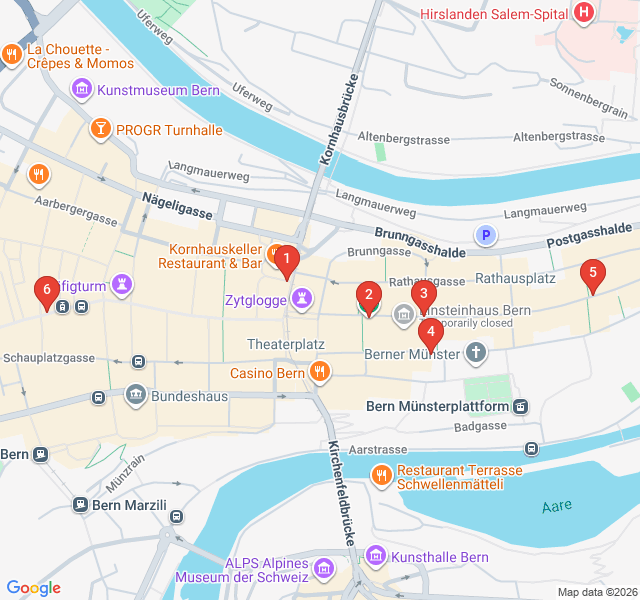
Numbers indicate the order of stops on the tour.
Start your self-guided adventure at Kornhausplatz with one of the most striking and slightly disturbing statues in Europe. The Kindlifresserbrunnen, or Child Eater Fountain, depicts a giant devouring a naked child while holding a sack of more terrified infants. Created around 1545, its exact meaning remains a mystery that locals love to debate. Some believe it represents Krampus, the folkloric figure who punishes naughty children, while others suggest it was a warning to the city's youth to stay away from the deep bear pits nearby. Some darker theories link it to the blood libel myths of the era. Regardless of its origin, the statue serves as a powerful example of the 'memento mori' style of Renaissance art, designed to provoke strong emotions and moral reflection in everyone who passed by to collect their daily water.
As you move toward the Zytglogge clock tower, you encounter the Zähringerbrunnen. This fountain is a tribute to Berchtold V, Duke of Zähringen, who founded Bern in 1191. Look closely at the central figure: it is a bear, the heraldic animal of the city, wearing full plate armor and carrying the Zähringen banner. At the bear's feet, a smaller bear cub happily munches on grapes, a detail often missed by casual passersby. This statue symbolizes the strength and protection of the city’s founding dynasty. The bear’s armor is historically accurate for the 16th century, showcasing the incredible craftsmanship of Hans Gieng. It’s a perfect spot to reflect on the legendary story of how Bern got its name—supposedly from the first animal the Duke encountered during a hunt.
Continuing down Kramgasse, the Simsonbrunnen stands as a testament to the influence of the biblical Samson. This fountain depicts the hero wrestling a lion, a classic symbol of strength and courage. In the context of 16th-century Bern, Samson represented the power of the local merchant guilds and the city's own resilience. The fountain was paid for by the butchers' guild, who saw Samson’s physical prowess as a reflection of their own trade. Notice the vibrant colors—these fountains are repainted periodically to maintain their original Renaissance brilliance. The water flowing here, like most of Bern’s fountains, is fresh mountain water and perfectly safe to drink, continuing a tradition of public service that has lasted for centuries.
Located in Münsterplatz, the Mosesbrunnen offers a shift toward the religious history of the city. Moses is shown holding the Ten Commandments, pointing specifically to the second commandment: 'Thou shalt not make unto thee any graven image.' This is a fascinating irony, given that he is a sculpted image himself! The fountain was erected after the Reformation reached Bern, serving as a reminder of the new Protestant laws and moral codes. The figure of Moses is depicted with 'horns' of light, a common mistranslation in Renaissance art originating from the Hebrew word for 'radiant.' Standing in the shadow of the great Bern Minster, this fountain highlights the intersection of civic law and spiritual guidance in the 1500s.
In the middle of Gerechtigkeitsgasse stands perhaps the most famous of all Bernese fountains: the Gerechtigkeitsbrunnen. Lady Justice is shown with her traditional attributes—the blindfold, the sword, and the scales. However, look at the base of the pillar. You will see four small figures: the Pope, the Sultan, the Holy Roman Emperor, and the Schultheiß (the local mayor). This was a radical political statement for the time, suggesting that Justice stands above all earthly powers, regardless of their status or religion. It is the only fountain in Bern that remains almost entirely in its original state, having survived centuries of urban change. It represents the Bernese ideal of a fair and balanced republic, answerable only to the law.
Your walking route concludes at the Pfeiferbrunnen on Spitalgasse. After seeing warriors, prophets, and judges, this fountain offers a more whimsical look at Renaissance life. The Bagpiper represents the traveling musicians and the common folk who brought entertainment to the city streets. He is dressed in bright, festive clothing, accompanied by a goose and a monkey, symbols of folly and lightheartedness. This fountain was originally located near a hostel for traveling minstrels. It serves as a reminder that while Bern was a city of strict laws and piety, it was also a place of celebration, music, and community. Take a moment to appreciate the lively details before finishing your stroll near the main station.
Start Free on iPhone
Explore “Fountains and Folklore: The Statues of Bern” with your very own Private Tour Guide with Zigway. Start free on iPhone, skip the large group and the fixed routes, and hear the city come alive as you go.
Your Private Tour Guide
Don't miss the good stuff
Explore Freely
 Moderate
Bern, Switzerland
Explore Bern's historic lower city, a riverside district of secret dialects, industrial heritage, and alternative culture on this self-guided walk.
 Easy
EasyBern, Switzerland
Follow Albert Einstein’s footsteps through Bern’s Old Town on this self-guided walk exploring the birthplace of the Theory of Relativity.
 Easy
EasyBern, Switzerland
Discover Bern's cultural heart in Kirchenfeld. Explore world-class museums and stunning views on this self-guided walk.
 Easy
EasyBern, Switzerland
Discover Bern's creative heart. A self-guided walk through the street art, alternative culture, and local hangouts of the Lorraine neighborhood.
 Easy
EasySalzburg, Austria
Discover the 'Rome of the North' on this self-guided walk through the Baroque squares and monumental legacy of Salzburg’s Prince-Archbishops.
 Easy
EasyNairobi, Kenya
Explore Nairobi's architectural evolution from colonial-era landmarks to iconic Brutalist skyscrapers on this historic self-guided walking route.
 Easy
EasyNairobi, Kenya
Discover Nairobi's iconic skyline on this self-guided architecture walk through the CBD’s most famous modernist and Brutalist landmarks.
 Easy
EasyKrakow, Poland
Uncover Krakow's legendary past on this self-guided walk from literary monuments to the fire-breathing Wawel Dragon.
 Easy
EasyGeneva, Switzerland
Explore Geneva's bohemian heart on this self-guided walk through flea markets, contemporary art galleries, and literary landmarks.
 Easy
EasyGeneva, Switzerland
Discover the lives of Rousseau and Voltaire on this self-guided literary walking route through the historic heart of Enlightenment-era Geneva.
 Moderate
Geneva, Switzerland
Uncover Geneva’s secrets on this self-guided walk through the Old Town’s historic streets, from the Reformation Wall to medieval cathedrals.
 Easy
EasyGeneva, Switzerland
Discover the Mediterranean soul of Geneva. Explore Carouge’s Sardinian architecture, artisan workshops, and hidden gardens on this self-guided walk.