Self-guided audio tour in Bern
Start Free on iPhone
Start free on iPhone to unlock this self-guided walking tour in Bern. Hear all the stories that make it amazing, walk at your own pace, and begin whenever you want.
Your Private Tour Guide
Bern is often celebrated for its medieval Old Town, but just across the Aare River lies the Kirchenfeld district, a masterclass in 19th-century urban planning and cultural density. This neighborhood stroll takes you through what is affectionately known as the "Museum Mile," an area where grand architecture meets world-class collections. By following this walking route, you transition from the historic center into a leafy, sophisticated quarter that houses some of Switzerland’s most significant cultural institutions. The experience begins at the Alpine Museum of Switzerland, a space dedicated to the complex relationship between the Swiss people and their towering peaks. As you move through the district, you will encounter the monumental Helvetiaplatz, a square that serves as the gateway to this intellectual hub. The architecture here is a highlight in itself, ranging from the neo-Gothic castle aesthetic of the Bernisches Historisches Museum to the sleek, modern lines of the Museum of Communication. One of the most compelling aspects of this self-guided walk is the opportunity to explore the legacy of Albert Einstein. Within the Bernisches Historisches Museum, a dedicated section celebrates the physicist’s "annus mirabilis" in 1905, when he developed the theory of relativity while living in this very city. Beyond physics, the route offers a look into the natural world at the Naturhistorisches Museum, famous for its dioramas and the legendary rescue dog, Barry. This walking route Bern provides is more than just a sequence of buildings; it is an exploration of Swiss identity, scientific progress, and artistic expression. Whether you choose to enter every museum or simply admire the grand villas and diplomatic residences that line the streets, the Kirchenfeld district offers a peaceful yet intellectually stimulating alternative to the bustling city center. The journey concludes on the Kirchenfeldbrücke, an engineering marvel that provides one of the most iconic views of the Bernese skyline, including the Minster and the Federal Palace. This independent exploration allows you to set your own pace, lingering where your interests lie and skipping what doesn't appeal, making it a perfect cultural afternoon in the Swiss capital.
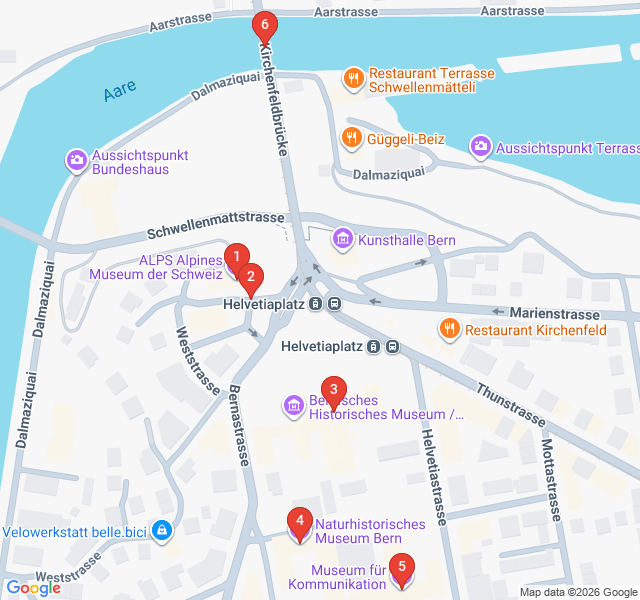
Numbers indicate the order of stops on the tour.
Begin your exploration at the Alpine Museum of Switzerland, a place where the mountains come to life through culture rather than just geology. Since 1905, this institution has explored the deep-seated relationship between the Swiss people and the Alps. The museum doesn't just show rocks and maps; it uses contemporary art, photography, and multimedia to discuss climate change, tourism, and mountain identity. Notice the building's functionalist style, which stands in contrast to the older villas nearby. It serves as a reminder that the Alps are a living, changing landscape that continues to shape the national psyche of Switzerland. It is the perfect starting point to understand the spirit of this alpine nation.
Step into Helvetiaplatz, the grand traffic hub and cultural plaza of the Kirchenfeld district. This square acts as a bridge between the medieval past of the Old Town and the modern, intellectual expansion of the 19th century. Surrounded by monumental buildings, the square is dominated by the 'Weltpostdenkmal' or World Postal Monument, which commemorates the founding of the Universal Postal Union in Bern. The square reflects the era when Bern established itself as a truly international city. From here, you can see the radiating streets that lead to various embassies and villas, showcasing the wealth and prestige that flowed into this neighborhood as Switzerland modernized.
Before you stands a building that looks like a fairy-tale castle. This is the Bernisches Historisches Museum, the second-largest historical museum in Switzerland. Designed in a historicist style by André Lambert, its towers and battlements are a spectacle of neo-Gothic architecture. Inside, the history of Bern is chronicled from the Stone Age to the present. However, its most famous resident is Albert Einstein. The physicist lived in Bern during his most productive years, and a significant portion of this museum is dedicated to his life and work, including his groundbreaking development of the theory of relativity. It is a site where medieval tapestries and quantum physics exist under one roof.
A short walk brings you to the Natural History Museum, an institution beloved by locals and researchers alike. While its façade is more understated than its neighbors, its contents are world-renowned. It is most famous for its extensive collection of dioramas featuring animals from around the globe, but the true star is 'Barry.' Barry was a Saint Bernard rescue dog who lived at the Great St. Bernard Hospice in the early 1800s and is credited with saving over 40 lives. His preserved form is a touchstone of Swiss folklore. The museum also houses one of the most significant collections of giant crystals found in the Alps, shimmering reminders of the treasures hidden beneath the peaks.
The Museum of Communication offers a shift in tone toward the interactive and the contemporary. This museum explores how humans have connected throughout history, from smoke signals and early postal routes to the digital age and social media. It is widely recognized for its innovative approach to exhibits, often winning awards for its engaging and family-friendly displays. The museum asks deep questions about how communication shapes our relationships and our society. Even from the outside, the building suggests a more modern, forward-thinking Bern, contrasting beautifully with the historic villas of the surrounding Kirchenfeld neighborhood.
Conclude your walk on the Kirchenfeldbrücke, the high-level iron bridge that spans the Aare River. Built between 1881 and 1883, this bridge was the catalyst for the development of the Kirchenfeld district you just explored. As you walk across, take a moment to look back at the Bernese skyline. The view is unparalleled: the towering spire of the Bern Minster, the turquoise waters of the Aare below, and the green dome of the Federal Palace. It is one of the most photographed spots in the city and provides a perfect panoramic summary of Bern’s blend of nature, history, and political power. From here, it is a short, scenic stroll back into the heart of the Old Town.
Start Free on iPhone
Explore “The Museum Mile of Kirchenfeld” with your very own Private Tour Guide with Zigway. Start free on iPhone, skip the large group and the fixed routes, and hear the city come alive as you go.
Your Private Tour Guide
Don't miss the good stuff
Explore Freely
 Moderate
Bern, Switzerland
Explore Bern's historic lower city, a riverside district of secret dialects, industrial heritage, and alternative culture on this self-guided walk.
 Easy
EasyBern, Switzerland
Follow Albert Einstein’s footsteps through Bern’s Old Town on this self-guided walk exploring the birthplace of the Theory of Relativity.
 Easy
EasyBern, Switzerland
Explore Bern's iconic 16th-century Renaissance fountains and uncover the legends behind the city's most famous statues on this self-guided walk.
 Easy
EasyBern, Switzerland
Discover Bern's creative heart. A self-guided walk through the street art, alternative culture, and local hangouts of the Lorraine neighborhood.
 Moderate
Vienna, Austria
Follow the footsteps of Mozart and Strauss through Vienna’s historic center on this self-guided walk through the city's rich musical history.
 Easy
EasyInnsbruck, Austria
Uncover the myths and legends of Innsbruck on this self-guided walk through the historic Altstadt and beyond.
 Easy
EasyGdansk, Poland
Discover the opulent Royal Way of Gdansk at your own pace. Explore Hanseatic history, gilded architecture, and the iconic Neptune's Fountain.
 Easy
EasyGdansk, Poland
Discover the 'Baltic Gold' on this self-guided walk through Gdansk's historic mills, massive cathedrals, and the magical Mariacka Street.
 Easy
EasyGeneva, Switzerland
Explore Geneva's bohemian heart on this self-guided walk through flea markets, contemporary art galleries, and literary landmarks.
 Easy
EasyGeneva, Switzerland
Discover the lives of Rousseau and Voltaire on this self-guided literary walking route through the historic heart of Enlightenment-era Geneva.
 Moderate
Geneva, Switzerland
Uncover Geneva’s secrets on this self-guided walk through the Old Town’s historic streets, from the Reformation Wall to medieval cathedrals.
 Easy
EasyGeneva, Switzerland
Discover the Mediterranean soul of Geneva. Explore Carouge’s Sardinian architecture, artisan workshops, and hidden gardens on this self-guided walk.