Self-guided audio tour in Istanbul
Start Free on iPhone
Start free on iPhone to unlock this self-guided walking tour in Istanbul. Hear all the stories that make it amazing, walk at your own pace, and begin whenever you want.
Your Private Tour Guide
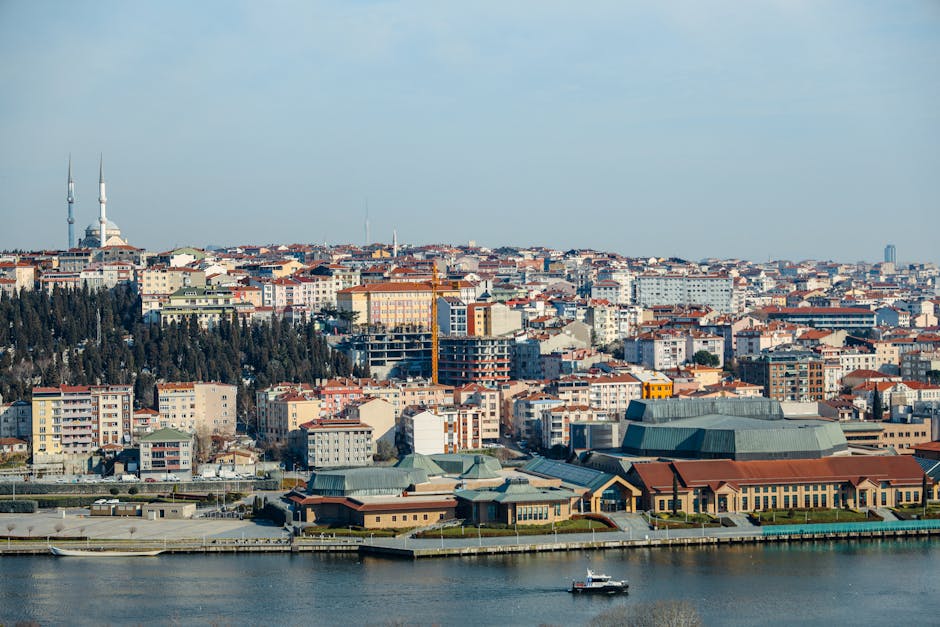
Istanbul's skyline is defined by the silhouettes of its imperial mosques, but none carry the weight of history quite like the Süleymaniye complex. This self-guided walk invites you into the heart of the Fatih district, a neighborhood where the legacies of three empires—Roman, Byzantine, and Ottoman—intersect within a few city blocks. The journey centers on the work of Mimar Sinan, the legendary chief architect who transformed the face of the city during the 16th-century Golden Age of the Ottoman Empire. By exploring this neighborhood stroll, you will see how Sinan’s mathematical precision and aesthetic vision created structures that have withstood centuries of earthquakes and urban change. The route begins at the magnificent Süleymaniye Mosque, a structure so vast it functioned as a city within a city, housing schools, hospitals, and kitchens. From there, the walking route leads you to more intimate sites, like the modest tomb of Sinan himself, before diving into the local character of the Vefa district. Here, the aroma of fermented boza fills the air, and Roman engineering stands tall in the form of the massive Aqueduct of Valens. This journey is more than just a look at grand monuments; it is an exploration of how architecture serves as a bridge between eras. You will encounter former Byzantine monasteries that were meticulously converted into mosques, such as the Molla Zeyrek and Kalenderhane, revealing the complex layers of Istanbul’s religious and cultural identity. For those seeking a walking tour Istanbul experience that escapes the main tourist hubs of Sultanahmet, this route offers a deeper, more atmospheric look at the 'Third Hill' of the city. Whether you are an architecture enthusiast or a history buff, this self-guided adventure provides the freedom to linger under ancient arches and soak in the views of the Golden Horn at your own pace.
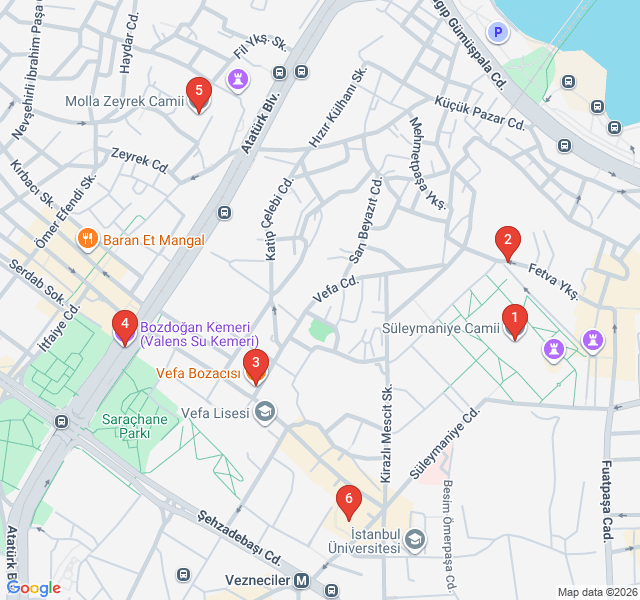
Numbers indicate the order of stops on the tour.
Commissioned by Sultan Suleiman the Magnificent and completed in 1557, this mosque is the crowning achievement of Mimar Sinan. As you stand in the courtyard, notice the perfect proportions and the four minarets, signifying that Suleiman was the fourth sultan to rule from Istanbul. Inside, Sinan used hundreds of empty clay pots embedded in the dome to create perfect acoustics, while a clever ventilation system drew soot from thousands of oil lamps into a single chamber to be collected for ink. The complex was a 'külliye'—a social hub containing a hospital, library, and soup kitchen that fed the poor regardless of their faith.
Just outside the walls of his greatest masterpiece lies the modest tomb of the man who built it. Mimar Sinan, who lived to be nearly 100 years old and served three sultans, designed this simple, triangular resting place himself. Compared to the lavish imperial tombs nearby, Sinan’s tomb is remarkably understated, reflecting the humility of a craftsman who rose from the Janissary corps to become the most influential architect in Islamic history. The location is symbolic; he is buried at the edge of the complex he loved most, forever watching over the skyline he helped define.
Step into a living piece of 19th-century Istanbul. Established in 1876, this shop serves 'boza,' a thick, slightly tart fermented grain drink topped with cinnamon and roasted chickpeas. It was a favorite of Mustafa Kemal Atatürk, the founder of modern Turkey; you can still see the silver cup he used preserved in a glass case on the wall. The interior remains largely unchanged, with its ornate tiling and marble counters. Drinking boza is a quintessentially Istanbul experience, especially in the cooler months, offering a brief, sweet pause in your architectural exploration.
Known in Turkish as Bozdoğan Kemeri, this massive Roman structure was completed in 368 AD during the reign of Emperor Valens. It was a critical link in the city's water system, carrying water from the hills outside the city to the Great Palace and various cisterns. Though it has survived countless earthquakes and the fall of empires, about 900 meters of the original structure remain. Standing beneath its double-tiered arches, you get a true sense of the Roman engineering that allowed a city of hundreds of thousands to thrive in a region with few natural water sources.
This building was originally the Monastery of the Pantokrator, one of the largest and most important religious complexes of the Middle Byzantine period. Built in the 12th century, it consists of three interconnected churches. After the Ottoman conquest, it was converted into a mosque and named after Molla Zeyrek, a scholar who taught here. Look closely at the brickwork and the recessed arches; they are classic examples of the Palaiologan Renaissance style. The site offers a fascinating look at how the Ottomans repurposed Byzantine structures, preserving their form while changing their function.
Our final stop is a hidden gem that reveals the layered history of the Fatih district. Originally a 6th-century Byzantine church built on the site of a Roman bath, it has served as a Greek Orthodox church, a Roman Catholic church during the Crusades, and finally an Ottoman mosque. Its unique cross-plan architecture is a rarity in the city. The name 'Kalenderhane' comes from the Kalenderi dervishes who used the building as a lodge in the 18th century. It stands as a silent witness to the religious shifts that have shaped Istanbul over the last 1,500 years.
Start Free on iPhone
Explore “Süleymaniye: The Master Architect's Legacy” with your very own Private Tour Guide with Zigway. Start free on iPhone, skip the large group and the fixed routes, and hear the city come alive as you go.
Your Private Tour Guide
Don't miss the good stuff
Explore Freely
 Easy
EasyIstanbul, Turkey
Explore the Bosphorus waterfront from Beşiktaş to Ortaköy. Discover imperial palaces, vibrant markets, and iconic mosques at your own pace.
 Moderate
Istanbul, Turkey
Explore the vibrant colors and deep history of Fener and Balat on this self-guided audio walk through Istanbul's most photogenic neighborhoods.
 Easy
EasyIstanbul, Turkey
Discover the flavors of Istanbul's Asian side on this self-guided walk through the vibrant markets and historic eateries of Kadıköy.
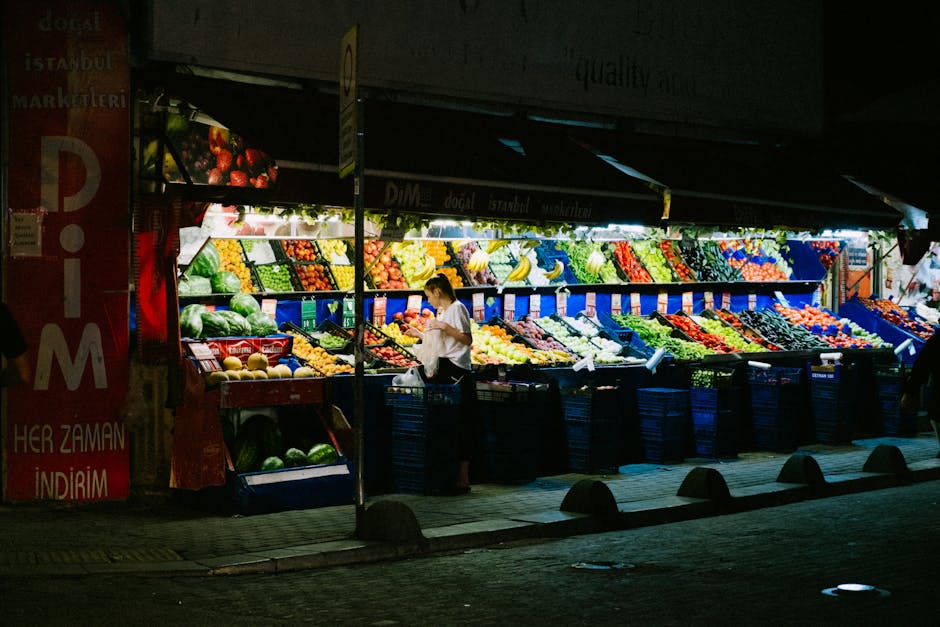 Moderate
Istanbul, Turkey
Discover hidden courtyards, artisan workshops, and the sensory magic of Istanbul's historic markets on this immersive self-guided walking route.
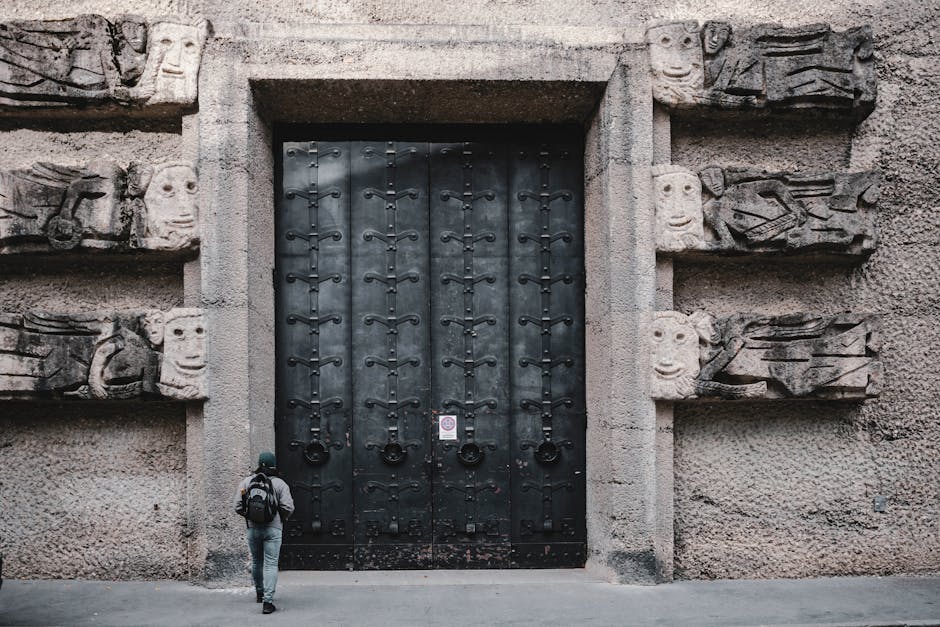 Easy
EasySalzburg, Austria
Discover the 'Rome of the North' on this self-guided walk through the Baroque squares and monumental legacy of Salzburg’s Prince-Archbishops.
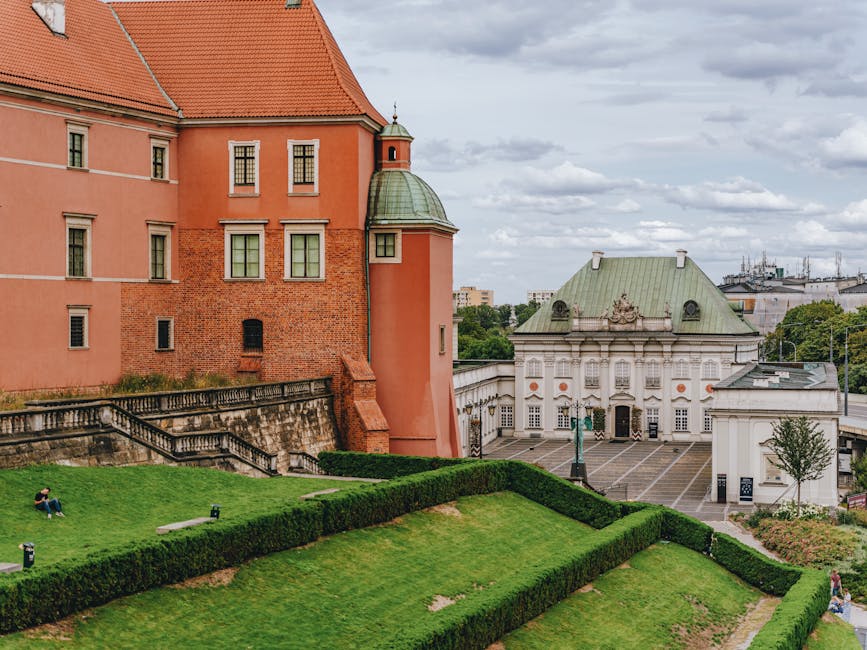 Moderate
Warsaw, Poland
Explore the resilient spirit of Warsaw's Muranów district on this self-guided walk through the history and landmarks of the former Jewish Ghetto.
 Easy
EasyGothenburg, Sweden
Discover Gothenburg’s 17th-century Dutch foundations, historic canals, and military fortifications on this self-guided architectural walk.
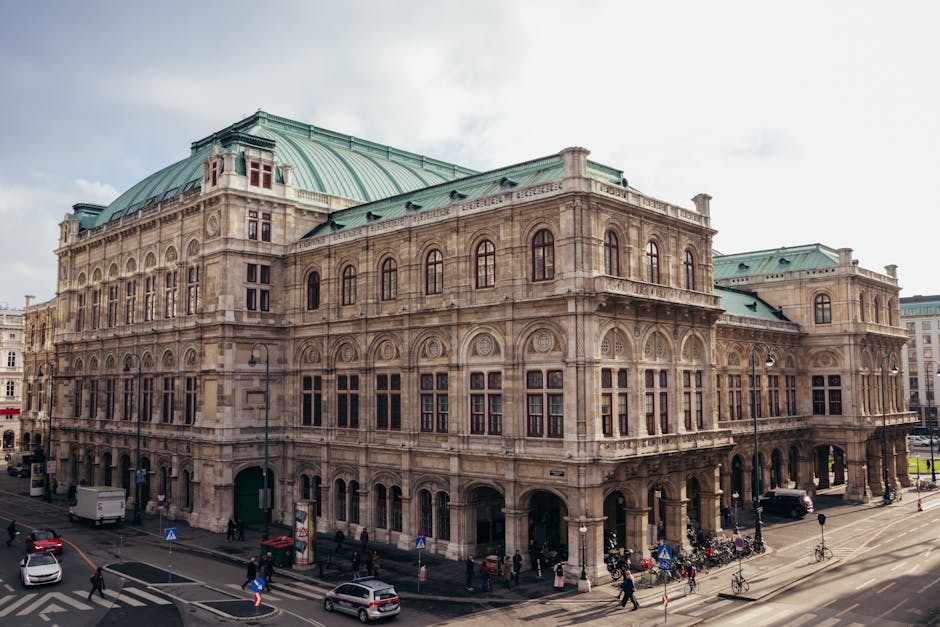 Moderate
Vienna, Austria
Follow the footsteps of Mozart and Strauss through Vienna’s historic center on this self-guided walk through the city's rich musical history.
 Moderate
Cappadocia, Turkey
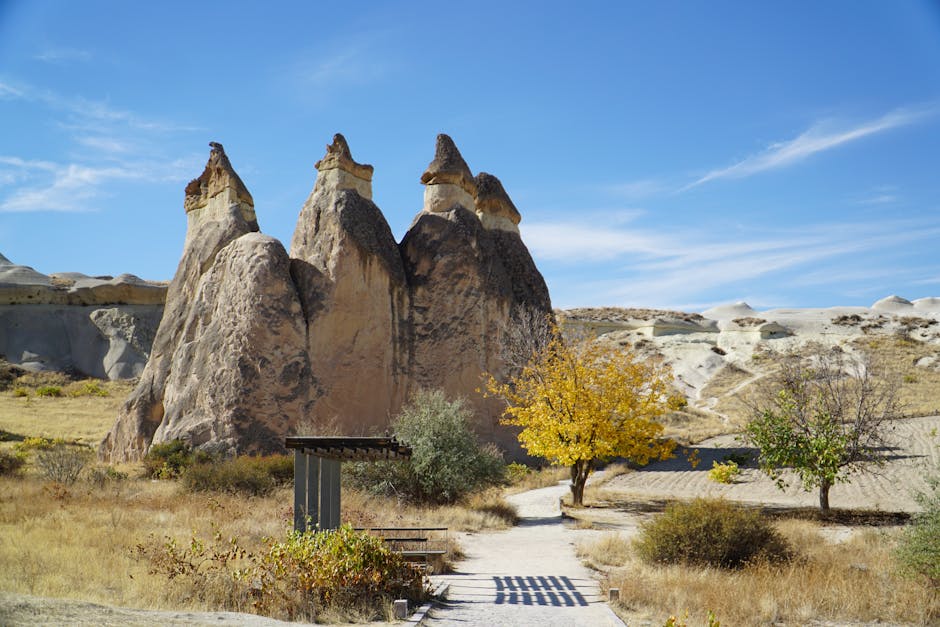
Explore the surreal landscapes and ancient dovecotes of Pigeon Valley on this scenic self-guided walk between Göreme and Uçhisar.
 Moderate
Cappadocia, Turkey
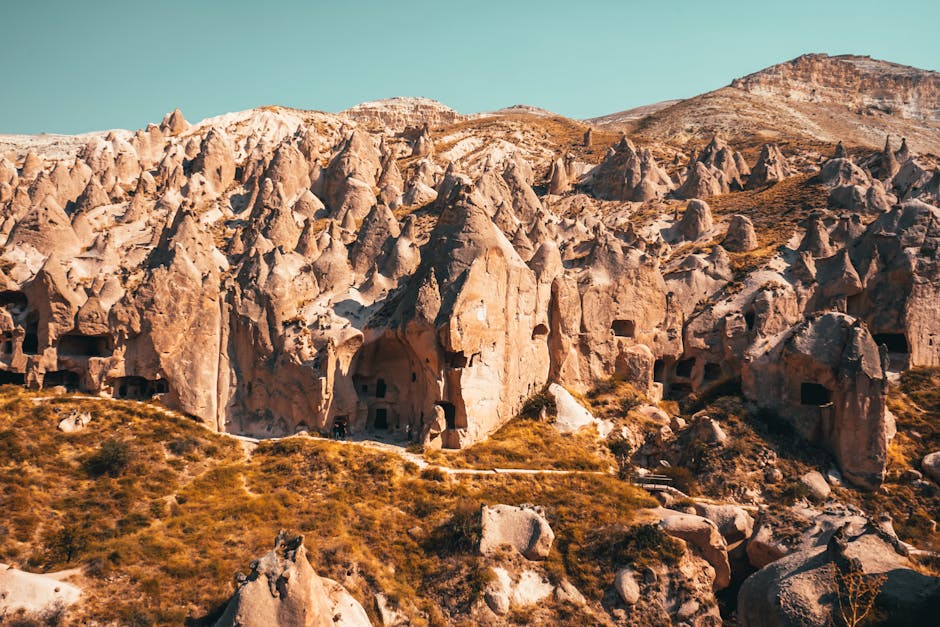
Explore Ortahisar’s towering rock castle, ancient cave monasteries, and authentic village life on this self-guided walk through Cappadocia.
 Easy
EasyCappadocia, Turkey
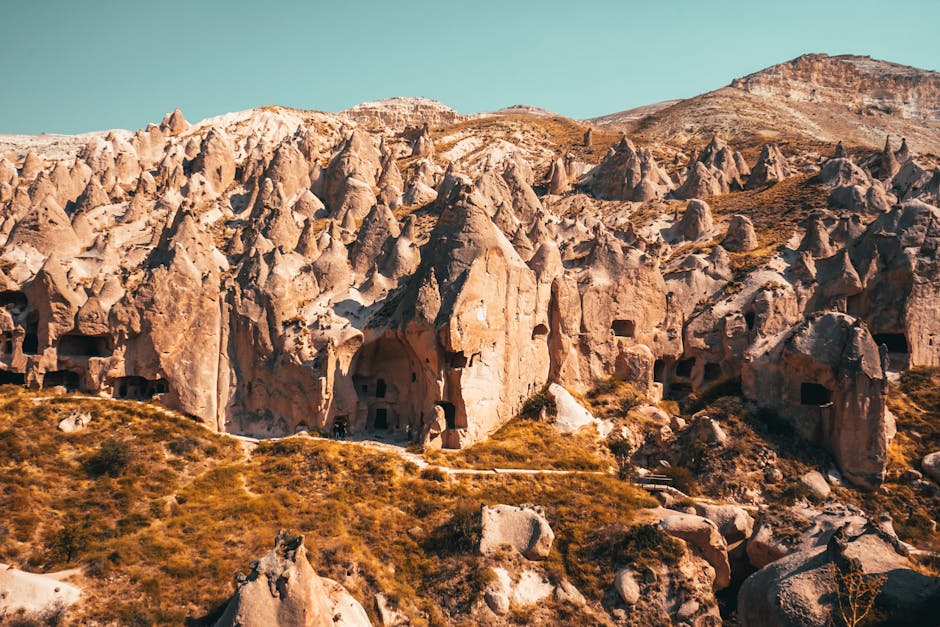
Explore Ürgüp’s elegant stone mansions, famous fairy chimneys, and rich wine heritage on this self-guided neighborhood stroll through Cappadocia.
 Moderate
Cappadocia, Turkey
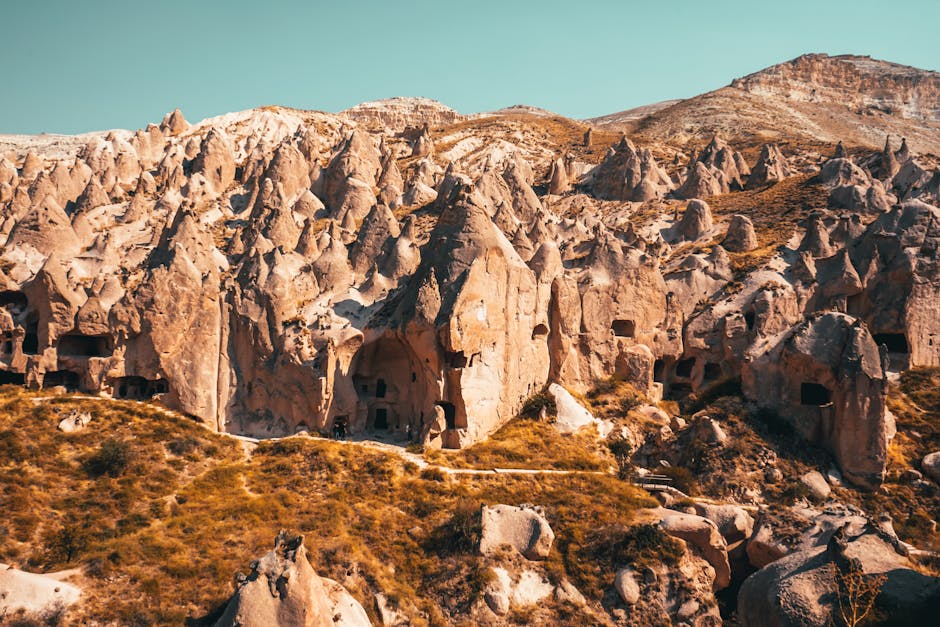
Explore abandoned rock-cut homes and ancient Byzantine churches in Cappadocia’s haunting ghost village on this self-guided audio walk.