Self-guided audio tour in Helsinki
Start Free on iPhone
Start free on iPhone to unlock this self-guided walking tour in Helsinki. Hear all the stories that make it amazing, walk at your own pace, and begin whenever you want.
Your Private Tour Guide
Step into the grand architectural vision of 19th-century Helsinki with this self-guided walk through the city’s Neoclassical core. Often called the 'St. Petersburg of the North,' the Kruununhaka district showcases a unique blend of imperial Russian ambition and Finnish national identity. This walking route invites you to explore the monumental Senate Square, where the harmony of the surrounding buildings creates one of the most cohesive urban spaces in Europe. As you embark on this neighborhood stroll, you will encounter the work of architect Carl Ludvig Engel, who was tasked with rebuilding Helsinki after it became the capital of the Grand Duchy of Finland in 1812. The centerpiece is the iconic Helsinki Cathedral, a soaring white landmark that dominates the skyline. This area is not just about religious monuments; it is the heart of Finnish power and knowledge. You will pass the Bank of Finland and the House of the Estates, buildings that tell the story of a nation finding its voice through its institutions. Beyond the grand facades, this walking route Helsinki offers a chance to see the city's oldest stone house, providing a glimpse into life before the Neoclassical transformation. This self-guided adventure is perfect for those who appreciate history and design, allowing you to linger at each site without the pressure of a group. Whether you are a first-time visitor or a repeat traveler, discovering the 'White City of the North' independently allows for a deeper connection with the quiet majesty of Finnish architecture. The streets are wide, the atmosphere is dignified, and the history is palpable at every corner of this historic district. This self-guided walk Helsinki ensures you see the most significant landmarks of the Kruununhaka neighborhood at your own pace.
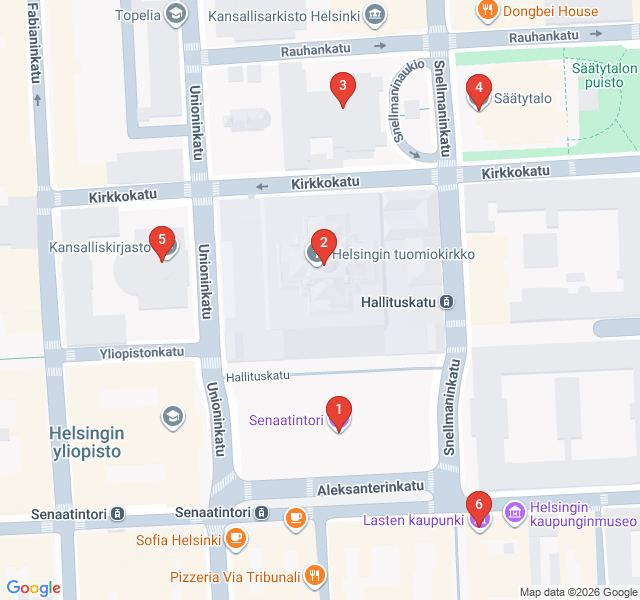
Numbers indicate the order of stops on the tour.
Senate Square is the literal and figurative heart of Neoclassical Helsinki. Designed by Carl Ludvig Engel, the square represents a unique era when Finland was a Grand Duchy under the Russian Empire. Take a moment to look around: the four main buildings—the Cathedral, the Government Palace, the University of Helsinki main building, and the National Library—create a perfectly balanced ensemble. In the center stands the statue of Tsar Alexander II, known as 'the Good Tsar' by Finns for granting the country greater autonomy. The square is a masterpiece of early 19th-century urban planning, intended to reflect the dignity and order of the new capital. Notice how the wide, open space emphasizes the height of the Cathedral to the north.
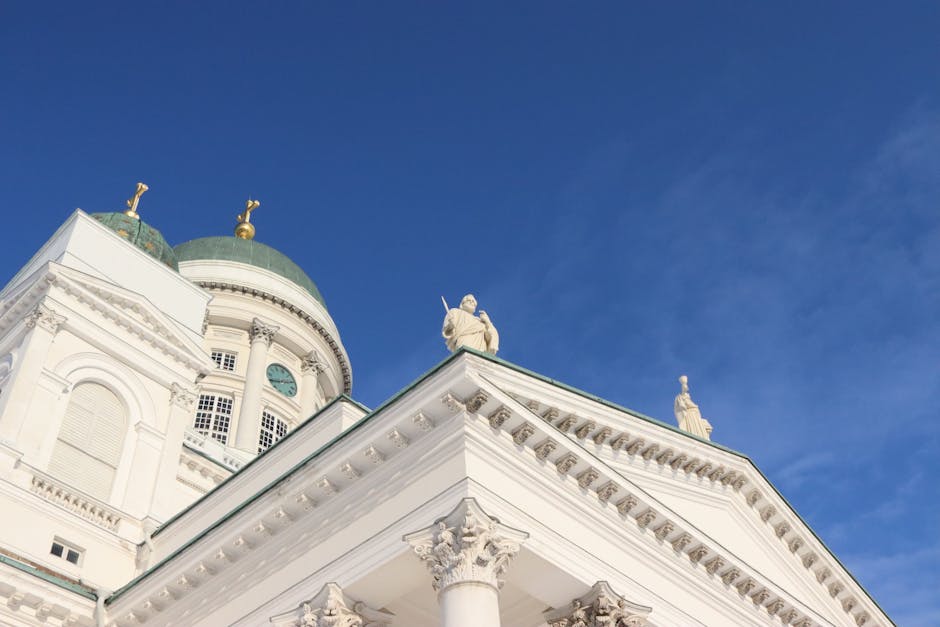
Dominating the skyline with its brilliant white walls and green domes, Helsinki Cathedral is the city's most recognizable landmark. Completed in 1852 as a tribute to Tsar Nicholas I, it was originally known as St. Nicholas' Church. The building is a classic example of the Empire style, featuring a Greek cross plan and four smaller domes added to reinforce the structure. If you look closely at the roof, you can see the twelve apostles—zinc statues that are among the largest of their kind in the world. The interior is surprisingly minimalist compared to the grand exterior, reflecting the Lutheran tradition. It remains an active place of worship and a symbol of Finnish national identity.
Moving away from the main square, you find the Bank of Finland, a building that exudes financial stability and power. Unlike the surrounding Empire-style buildings, this was designed by German architect Ludvig Bohnstedt in a Neo-Renaissance style and completed in 1883. In front of the bank stands a statue of J.V. Snellman, a philosopher and statesman who was instrumental in establishing the Finnish Markka currency. If you look at the pedestal of the statue, you might notice small indentations; these are bullet holes left from the massive aerial bombings Helsinki endured during World War II in 1944, preserved as a silent reminder of the city's resilience during the conflict.
Directly across from the Bank of Finland sits the House of the Estates, one of Helsinki's most ornamental buildings. Completed in 1891, it was built to house the three commoner estates of the Diet of Finland: the clergy, the burghers, and the peasants (the nobility met elsewhere). The facade is decorated with a magnificent frieze depicting the 1809 Diet of Porvoo, where Tsar Alexander I confirmed the Finnish laws and religion. Today, it is used for government meetings and official functions. The architecture here marks a transition toward more decorative, eclectic styles, yet it maintains the grand proportions necessary to fit into the neighborhood’s dignified atmosphere.
Often cited as Carl Ludvig Engel's finest achievement, the National Library is a temple of knowledge. The facade on Unioninkatu features grand Corinthian columns, mirroring the university building across the street. Inside, the library is famous for its stunning 'Rotunda' and the Cupola Hall, which are masterpieces of decorative painting and architectural symmetry. The library houses the national collective memory of Finland, including a copy of every printed work published in the country. It serves as a bridge between the academic world of the University and the political world of the Senate, completing the intellectual corner of this historic district.
To conclude this neighborhood stroll, we visit Sederholm House, located on the corner of Senate Square. Built in 1757, this is the oldest stone building in Helsinki's inner city. It predates the Neoclassical transformation and survived the Great Fire of 1808 that cleared the way for Engel's grand designs. Originally the home of merchant Johan Sederholm, it reflects the city's Swedish-era history and commercial roots. The modest proportions and simpler Baroque-influenced style offer a sharp contrast to the imperial scale of the Cathedral nearby. It now serves as part of the Helsinki City Museum, offering a window into the daily life of 18th-century residents.
Start Free on iPhone
Explore “Neoclassical Heart of Helsinki” with your very own Private Tour Guide with Zigway. Start free on iPhone, skip the large group and the fixed routes, and hear the city come alive as you go.
Your Private Tour Guide
Don't miss the good stuff
Explore Freely
 Moderate
Helsinki, Finland
Explore Helsinki's bohemian heart. Discover historic saunas, granite churches, and the vibrant local life of the Kallio neighborhood at your own pace.
 Easy
EasyHelsinki, Finland
Discover Helsinki's oldest neighborhood on this self-guided audio walk through Kruununhaka’s historic streets, hidden courtyards, and scenic shores.
 Moderate
Helsinki, Finland
Explore the 'Gibraltar of the North' on this independent walking route through the historic bastions and hidden gardens of Suomenlinna Sea Fortress.
 Easy
EasyHelsinki, Finland
Discover Helsinki's stunning Art Nouveau architecture and maritime history on this self-guided neighborhood stroll through Katajanokka.
 Easy
EasyNairobi, Kenya
Discover Nairobi's iconic skyline on this self-guided architecture walk through the CBD’s most famous modernist and Brutalist landmarks.
 Easy
EasyWarsaw, Poland
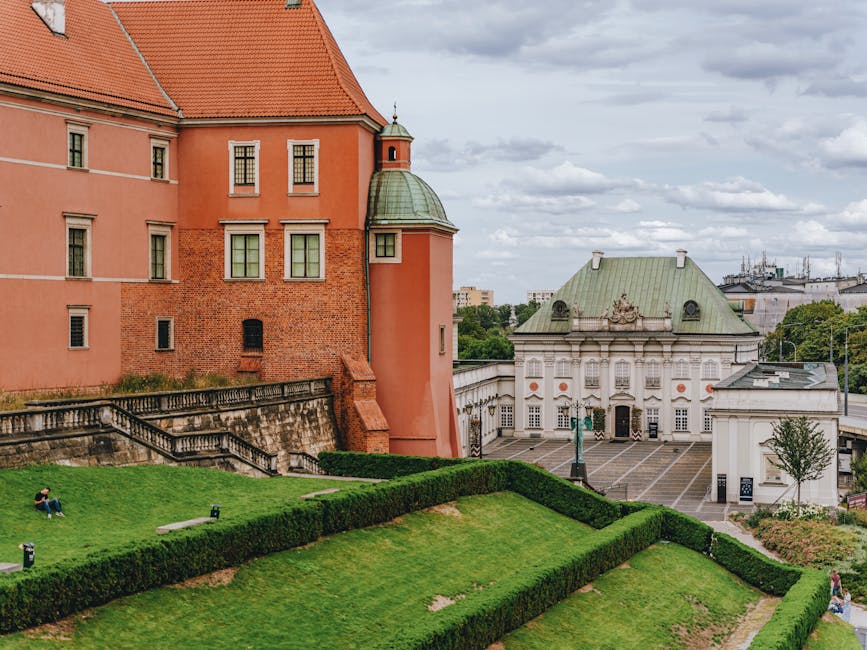
Explore the miracle of Warsaw's reconstructed Old Town on this self-guided walk through royal squares, medieval walls, and heroic monuments.
 Easy
EasyGothenburg, Sweden
Discover Gothenburg’s 17th-century Dutch foundations, historic canals, and military fortifications on this self-guided architectural walk.
 Easy
EasyNairobi, Kenya
Explore Nairobi's architectural evolution from colonial-era landmarks to iconic Brutalist skyscrapers on this historic self-guided walking route.