Self-guided audio tour in Washington DC
Start Free on iPhone
Start free on iPhone to unlock this self-guided walking tour in Washington DC. Hear all the stories that make it amazing, walk at your own pace, and begin whenever you want.
Your Private Tour Guide
Embark on a self-guided walk through the corridors of power and the shadows of scandal in Washington DC’s Foggy Bottom neighborhood. This neighborhood stroll takes you beyond the typical monuments, diving deep into the political intrigue that has shaped American history for over two centuries. From the temporary White House occupied after the British burned the city in 1814 to the hotel rooms where a 1970s break-in brought down a presidency, this walking route explores the intersection of architecture and clandestine history. Your independent exploration begins at The Octagon Museum, a masterpiece of Federal-style architecture that once served as a sanctuary for President James Madison. As you move through the urban campus of George Washington University, you will witness how the city’s academic and political spheres intertwine. The route transitions from the neoclassical elegance of the Corcoran School to the modernist curves of the Watergate Hotel, perhaps the most famous address in American political lore. You will learn about the 'plumbers' who orchestrated the infamous DNC break-in and the diplomatic secrets held within the nearby Saudi Arabian Embassy. This walking tour Washington DC offers a unique perspective on the city, focusing on the human drama and high-stakes gamesmanship of Foggy Bottom. As you reach the banks of the Potomac River, the journey concludes at the John F. Kennedy Center for the Performing Arts. Here, the theme of political legacy takes on a more solemn tone, offering a space for reflection amidst stunning panoramic views of the river and the city skyline. This self-guided adventure is perfect for history buffs and political junkies who want to see the real Washington DC at their own pace. Whether you are interested in the architectural evolution of the city or the gritty details of its most famous scandals, this walking tour Washington DC provides a comprehensive and engaging narrative of the capital’s most intriguing district.
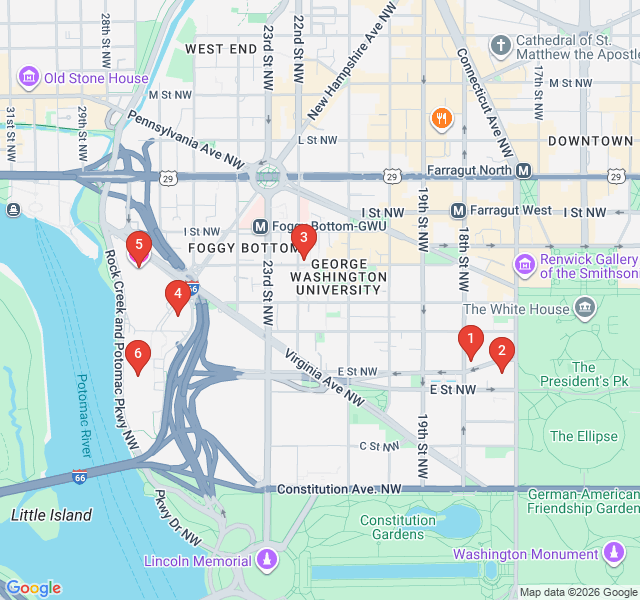
Numbers indicate the order of stops on the tour.
Welcome to one of the most historically significant private residences in the capital. Built between 1799 and 1801 for Colonel John Tayloe III, The Octagon is actually hexagonal in shape, designed to fit the unique geometry of DC’s street grid. Its most famous moment came after the War of 1812; when the British burned the White House, President James Madison and First Lady Dolley Madison moved here. It was in the circular upstairs study that Madison signed the Treaty of Ghent, officially ending the war. As you stand before this brick masterpiece, consider the weight of the decisions made within its walls during the young nation’s most precarious moments. It remains a symbol of the resilience of the American capital.
Just a short walk away is the Corcoran School of the Arts and Design. The building itself is a work of art, a premier example of Beaux-Arts architecture designed by Ernest Flagg in the late 19th century. Note the grand neoclassical facade and the names of Great Masters etched into the stone. Originally founded as the first private art museum in the United States, it eventually merged with George Washington University. This site represents the cultural soul of Foggy Bottom, where the rigorous world of politics meets the creative expression of the arts. It has served as a backdrop for countless gala events and protests alike, standing as a testament to the city's intellectual and artistic depth.
You are now in the heart of George Washington University, or GWU. Unlike many traditional campuses, GWU is fully integrated into the city's fabric. Its proximity to the World Bank, the IMF, and the White House makes it a breeding ground for future world leaders and diplomats. As you walk through these blocks, you are sharing the pavement with people who likely have a hand in shaping global policy. The university was established by an Act of Congress in 1821, fulfilling George Washington's own wish for a national university in the capital. The energy here is palpable—a mix of academic curiosity and high-level political ambition that defines the unique character of the Foggy Bottom neighborhood.
As we move toward the river, we encounter the Embassy of Saudi Arabia. This striking, modern building is a focal point of international diplomacy in Washington. In a city where 'soft power' is the primary currency, embassies like this one serve as sovereign outposts for foreign nations. The architecture is intentionally grand, reflecting the geopolitical importance of the relationship between the U.S. and the Kingdom. This area of Foggy Bottom is often buzzing with diplomatic motorcades and quiet negotiations. It serves as a reminder that while the local politics of the U.S. are fascinating, Washington DC is also a global stage where the interests of many nations converge and occasionally clash.
Here it is: the most scandalous address in America. The Watergate complex, with its distinctive curved balconies designed by Italian architect Luigi Moretti, was controversial even before the 1972 scandal due to its modernist look. However, its name became synonymous with political corruption when five men were arrested for breaking into the Democratic National Committee headquarters located here. This event eventually led to the resignation of President Richard Nixon. Today, the hotel embraces its history—the 'Scandal Room' is even decorated with 1970s memorabilia. As you look up at the complex, imagine the 'plumbers' and the secret informants who turned this luxury development into a permanent symbol of American political drama and the power of investigative journalism.
The final stop on our walking route is the John F. Kennedy Center. This massive marble structure, designed by Edward Durell Stone, serves as the national memorial to the 35th President. JFK was a great patron of the arts, and this center brings together theater, dance, and music under one roof. Take a moment to walk through the Hall of States or the Hall of Nations, where the flags of the world fly high. If you have time, head up to the rooftop terrace. From there, you can see the Watergate complex you just visited, the Potomac River, and the monuments in the distance. It is a place of beauty and reflection, standing in contrast to the intrigue of the nearby streets.
Start Free on iPhone
Explore “Scandal & Intrigue: The Watergate to Foggy Bottom” with your very own Private Tour Guide with Zigway. Start free on iPhone, skip the large group and the fixed routes, and hear the city come alive as you go.
Your Private Tour Guide
Don't miss the good stuff
Explore Freely
 Easy
EasyWashington DC, United States
Trace the footsteps of Abraham Lincoln and his conspirators on this self-guided history walk through the heart of Washington D.C.
 Moderate
Washington DC, United States
Explore Georgetown’s secret alleys, Kennedy family haunts, and cinematic landmarks on this self-guided walk through DC’s historic core.
 Easy
EasyWashington DC, United States
Uncover the scandals and secrets of Lafayette Square on this self-guided audio walk through the historic heart of Washington DC.
 Moderate
Washington DC, United States
Explore the vibrant street art and global culture of Adams Morgan on this self-guided audio walk through DC's most colorful neighborhood.
 Easy
EasyGothenburg, Sweden
Explore Gothenburg's elegant academic district, featuring grand 19th-century stone architecture and the iconic cultural hub of Götaplatsen.
 Easy
EasyKrakow, Poland
Explore the prestigious Jagiellonian University district, featuring Neo-Gothic architecture, Baroque churches, and Krakow's hidden scholarly gems.
 Easy
EasyGothenburg, Sweden
Discover Gothenburg’s 17th-century Dutch foundations, historic canals, and military fortifications on this self-guided architectural walk.
 Easy
EasyNairobi, Kenya
Discover Nairobi’s literary soul on this self-guided walk through historic libraries, iconic bookshops, and cultural centers in the heart of the CBD.
 Easy
EasyNashville, United States
Explore the 'Athens of the South' on this self-guided walk through Centennial Park, featuring the world's only full-scale Parthenon replica.
 Easy
EasyNashville, United States
Explore Nashville's academic heart and Art Deco gems on this self-guided walk through historic Hillsboro Village.
 Easy
EasyNashville, United States
Explore the heart of Nashville's music industry. Discover iconic studios and the history of the legendary Nashville Sound at your own pace.
 Easy
EasyNashville, United States
Explore Nashville's oldest neighborhood! Discover Victorian architecture, Civil War history, and world-class craft beer on this self-guided walk.