Self-guided audio tour in Munich
Start Free on iPhone
Start free on iPhone to unlock this self-guided walking tour in Munich. Hear all the stories that make it amazing, walk at your own pace, and begin whenever you want.
Your Private Tour Guide
Munich is a city where the scent of roasting malt meets the grandeur of Bavarian royalty. This self-guided walk through the Altstadt, or Old Town, peels back the layers of history from the city's humble beginnings as a monastic settlement to its rise as a powerful seat of the Wittelsbach dynasty. Your neighborhood stroll begins at the world-renowned Hofbräuhaus, a site that perfectly encapsulates the city's dual devotion to beer and tradition. From there, you will traverse the winding alleys that lead to the Alter Hof, the very first imperial residence in the city, before emerging into the vibrant energy of Marienplatz. This route is designed to highlight the architectural shifts of the city, moving from the towering Gothic spires of the Frauenkirche to the neoclassical elegance of Odeonsplatz. Along the way, you will encounter the intricate clockwork of the Glockenspiel, the legendary 'Devil's Footstep,' and the sprawling complex of the Munich Residence. Whether you are interested in the political intrigues of the Bavarian kings or the cultural significance of the 1516 Beer Purity Law, this walking route offers a comprehensive look at the city's identity. This is not a formal guided tour Munich visitors might expect; instead, it is a flexible, independent exploration that allows you to pause for a pretzel or a photo whenever the mood strikes. By following this walking tour Munich reveals itself as a city of deep-seated traditions and resilient beauty, having painstakingly restored its historic core to its former glory. Discover the stories behind the facades and understand why Munich remains the 'city with a heart.'
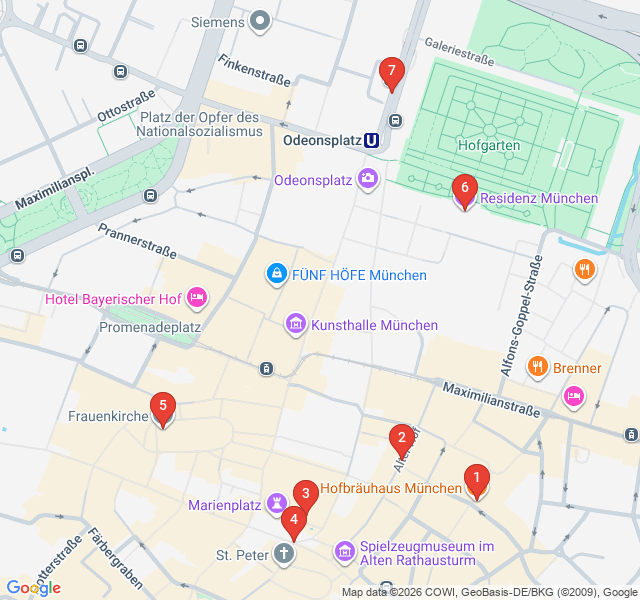
Numbers indicate the order of stops on the tour.
Welcome to the world's most famous tavern. Founded in 1589 by Duke Wilhelm V, the Hofbräuhaus was born out of a royal necessity: the Bavarian court was spending too much money importing beer from Saxony. Initially, it only brewed brown ale, but it soon became the cornerstone of Munich's social fabric. As you stand before this Neo-Renaissance building, imagine the centuries of 'Stammtisch' groups—regulars who have their own reserved tables and personalized beer mugs locked in cages. The building you see today was largely reconstructed after WWII, but the spirit remains unchanged. It was here that the Beer Purity Law was fiercely upheld, ensuring that only water, hops, and barley (and later yeast) were used. It is a temple to Bavarian hospitality and the perfect place to begin understanding the local culture.
Tucked away from the main thoroughfares is the Alter Hof, the first residence of the Wittelsbach dynasty. This courtyard dates back to the 12th century and served as the imperial seat for Holy Roman Emperor Louis the Bavarian in the 1300s. Look up at the wooden oriel window known as the 'Monkey Tower.' Legend has it that a pet monkey belonging to the court once snatched the infant Louis from his cradle and climbed to the top of the tower, only returning him once the baby had fallen asleep. While much of the complex was rebuilt after wartime destruction, the late-Gothic architecture provides a quiet glimpse into Munich’s medieval heart, long before the more famous Residence was constructed.
Dominating the north side of Marienplatz is the Neues Rathaus, or New Town Hall. Despite its ancient appearance, this Flemish Gothic-inspired masterpiece was actually completed in 1905. It is most famous for its Glockenspiel, the fourth-largest of its kind in Europe. The 43 bells and 32 life-sized figures perform two stories: the upper tier depicts the marriage of Duke Wilhelm V, featuring a joust where the Bavarian knight always wins, while the lower tier shows the 'Schäfflertanz,' or Coopers' Dance. This dance was said to have been performed in 1517 to cheer up the citizenry after a plague. The building’s facade is a stone tapestry of Bavarian legends, kings, and allegorical figures, serving as a proud symbol of Munich’s civic identity.
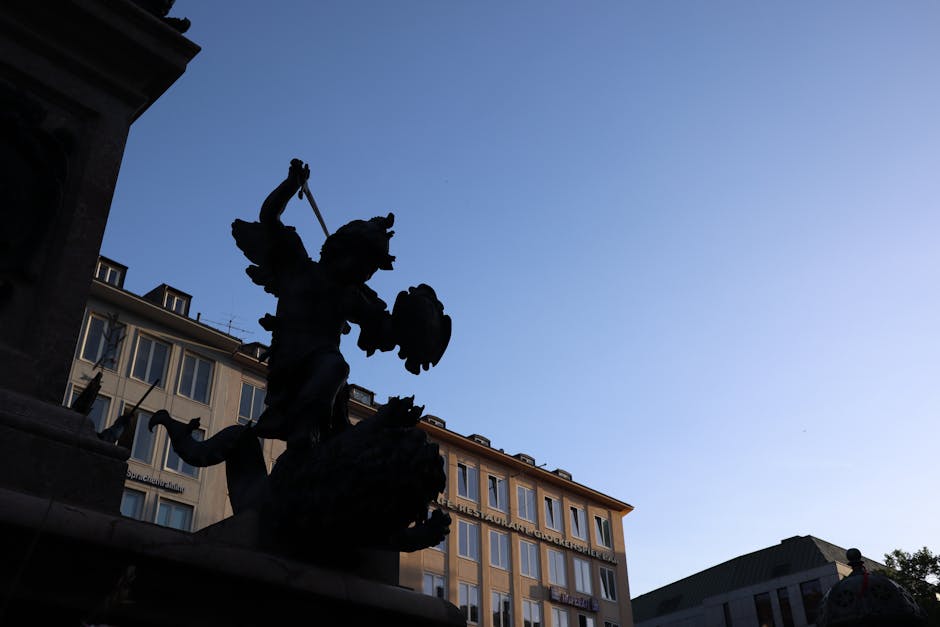
Marienplatz has been the city’s central square since Munich was founded in 1158. Originally a salt and grain market, it is named after the Mariensäule, the golden Column of Mary at its center. Erected in 1638, the column celebrates the end of the Swedish occupation during the Thirty Years' War. At the base, four brave putti are seen fighting off beasts representing war, pestilence, hunger, and heresy. Nearby, you will find the Fischbrunnen, or Fish Fountain. It is a traditional spot for locals to meet, and on Ash Wednesday, it’s the site of a quirky tradition where the mayor washes the city's empty purse in the water, hoping for a prosperous year ahead. This square is the beating heart of the city, connecting the old and new worlds of Munich.
The Cathedral of Our Dear Lady, with its distinctive twin onion domes, is Munich’s most recognizable landmark. Completed in 1488, this brick Gothic giant was built in just 20 years. Upon entering, look for the 'Teufelstritt,' or Devil's Footstep, a dark mark in the floor near the entrance. Local lore claims the architect made a deal with the devil to build a church with no windows. When the devil stood at this spot, the pillars blocked all the windows from view, and in his triumph, he stomped his foot, leaving the mark. When he realized he'd been tricked, he turned into a wind that still whistles around the towers today. The domes themselves were modeled after the Dome of the Rock in Jerusalem, a design choice that became a trend for Bavarian village churches for centuries.
The Residenz is the largest city palace in Germany and served as the seat of government and residence for Bavarian dukes, electors, and kings from 1385 to 1918. What started as a small castle grew into a sprawling complex of 13 courtyards and over 130 rooms. As you walk along the Residenzstraße facade, notice the bronze lions guarding the entrances. It is a local tradition to rub the small shields held by these lions for good luck—you can see how shiny they have become from millions of hands. The palace reflects a mix of Renaissance, Baroque, Rococo, and Neoclassical styles, showcasing the evolving tastes and immense wealth of the Wittelsbach family over half a millennium.
Our walk concludes at Odeonsplatz, a square that feels more like Florence than Germany. This was the vision of King Ludwig I, who wanted to bring Italian classicism to Munich. To your left is the Theatinerkirche, a stunning yellow Baroque church inspired by Sant'Andrea della Valle in Rome. Directly ahead is the Feldherrnhalle, a loggia built in the 1840s to honor the Bavarian army, modeled after the Loggia dei Lanzi in Florence. This square has seen the city's highest and lowest moments, from royal parades to the failed Beer Hall Putsch of 1923. Today, it serves as a gateway to the Hofgarten and the museum district, marking the transition from the old royal city to the modern cultural capital.
Start Free on iPhone
Explore “The Heart of Old Munich: Monks, Kings, and Clockwork” with your very own Private Tour Guide with Zigway. Start free on iPhone, skip the large group and the fixed routes, and hear the city come alive as you go.
Your Private Tour Guide
Don't miss the good stuff
Explore Freely
 Easy
EasyMunich, Germany
Explore Munich's creative heartbeat in Werksviertel-Mitte. Discover vibrant street art, upcycled containers, and rooftop sheep on this urban stroll.
 Moderate
Munich, Germany
Discover river surfing, iconic Greek temples, and Bavarian beer culture on this scenic self-guided walk through Munich's English Garden.
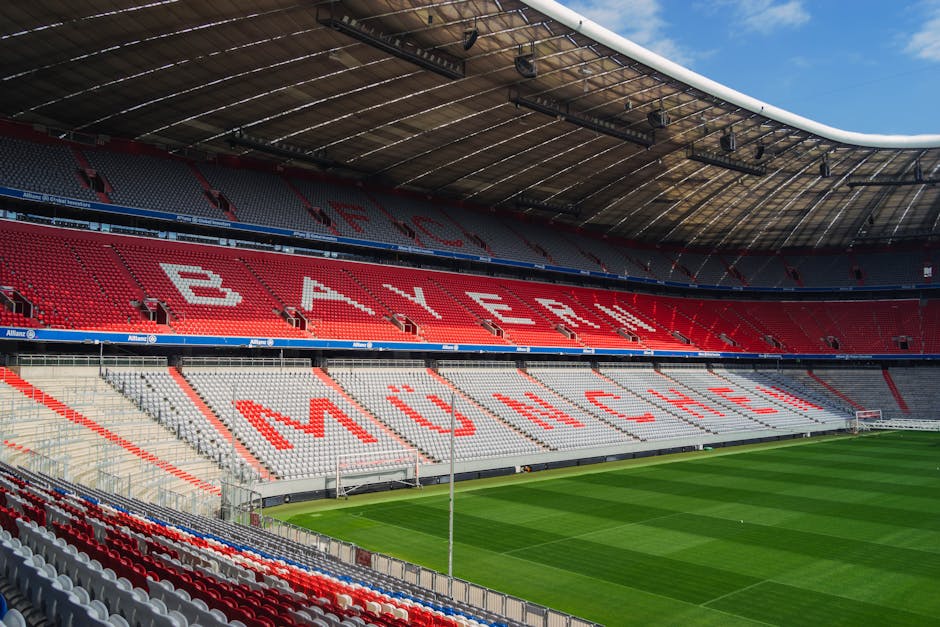 Easy
EasyMunich, Germany
Discover Munich's culinary heart on this self-guided walk through the vibrant Viktualienmarkt and its legendary food stalls.
 Easy
EasyMunich, Germany
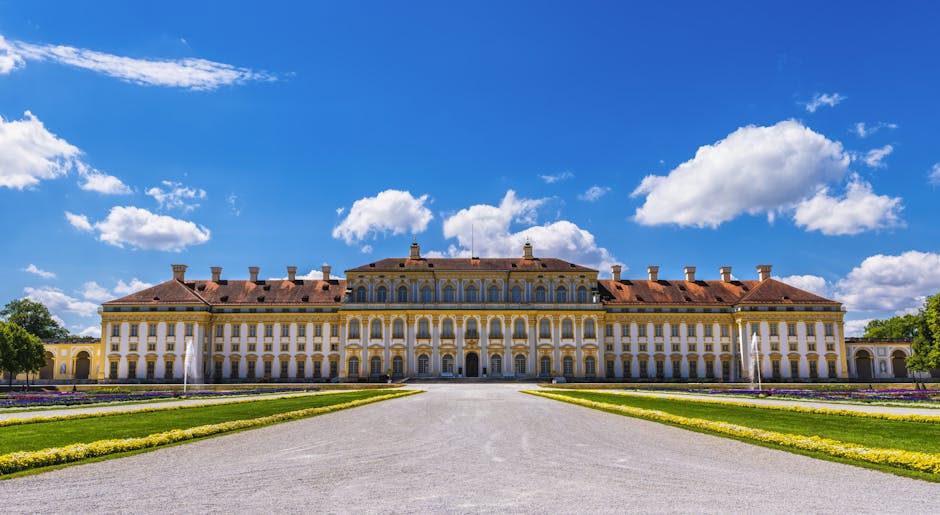
Explore the majestic gardens and hidden pavilions of the Wittelsbach summer residence on this peaceful, self-guided walking route in Munich.
 Easy
EasyNairobi, Kenya
Explore Nairobi's architectural evolution from colonial-era landmarks to iconic Brutalist skyscrapers on this historic self-guided walking route.
 Easy
EasyNairobi, Kenya
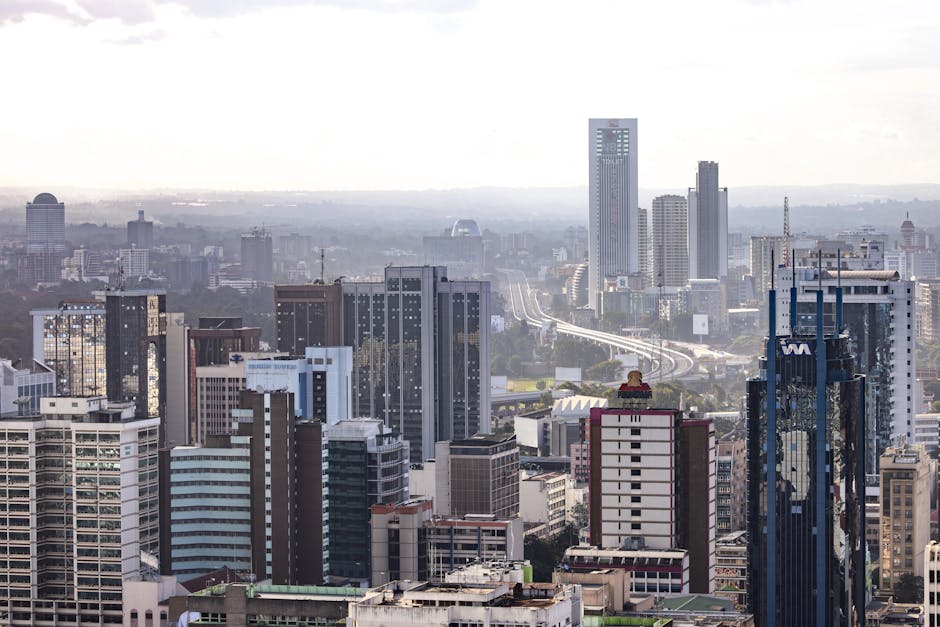
Discover Nairobi's iconic skyline on this self-guided architecture walk through the CBD’s most famous modernist and Brutalist landmarks.
 Easy
EasyGdansk, Poland
Discover the opulent Royal Way of Gdansk at your own pace. Explore Hanseatic history, gilded architecture, and the iconic Neptune's Fountain.
 Easy
EasySalzburg, Austria
Discover the 'Rome of the North' on this self-guided walk through the Baroque squares and monumental legacy of Salzburg’s Prince-Archbishops.
 Easy
EasyBerlin, Germany
Explore the sites of Nazi power and the memorials that honor its victims on this self-guided walk through Berlin's historic Wilhelmstraße district.
 Moderate
Berlin, Germany
Explore Berlin’s 'Green Heart' on a self-guided walk through royal history, Cold War memorials, and serene lakeside gardens.
 Moderate
Berlin, Germany
Discover the legacy of the Berlin Wall on this self-guided walk from historic ghost stations to the vibrant street art and cafes of Mauerpark.
 Easy
EasyBerlin, Germany
Discover the soul of 1920s Berlin on a self-guided walk through Charlottenburg’s iconic literary cafes, historic theaters, and artistic landmarks.