Self-guided audio tour in Amsterdam
Start Free on iPhone
Start free on iPhone to unlock this self-guided walking tour in Amsterdam. Hear all the stories that make it amazing, walk at your own pace, and begin whenever you want.
Your Private Tour Guide
Beyond the neon lights of the Red Light District and the bustling commerce of Dam Square lies a quieter, more spiritual side of the city. This self-guided walk invites you to uncover Amsterdam’s secret sanctuaries, from the clandestine chapels of the 17th century to grand basilicas that redefine the skyline. During the Reformation in the late 1500s, Catholicism was officially banned in public life, leading to the creation of 'schuilkerken' or hidden churches. These were ordinary-looking canal houses that concealed magnificent, fully functional churches within their upper floors. On this neighborhood stroll, you will trace the history of religious tolerance and the architectural ingenuity that allowed faith to flourish behind closed doors. The route begins at one of the city's most remarkable sites, Our Lord in the Attic, where a wealthy merchant converted his top floors into a breathtaking sanctuary. As you explore independently, you will move from these modest exteriors to the imposing grandeur of the Basilica of Saint Nicholas, a symbol of the Catholic revival in the 19th century. The walking route also leads you into the heart of the Begijnhof, a medieval courtyard that remains an oasis of silence amidst the urban rush. Here, you can witness the architectural dialogue between the English Reformed Church and the hidden Catholic chapel across from it. Whether you are an architecture enthusiast or a history buff, this self-guided adventure offers a unique perspective on the Dutch Golden Age and the complex social fabric of the Netherlands. This is not a typical walking tour Amsterdam experience; it is a deep dive into the soul of the city at your own pace. Discover the intricate wood carvings of De Krijtberg and the stories of the Beguines who once called these courtyards home. By the end of this journey, you will see the familiar canals through the lens of those who once sought refuge and peace in these sacred spaces.
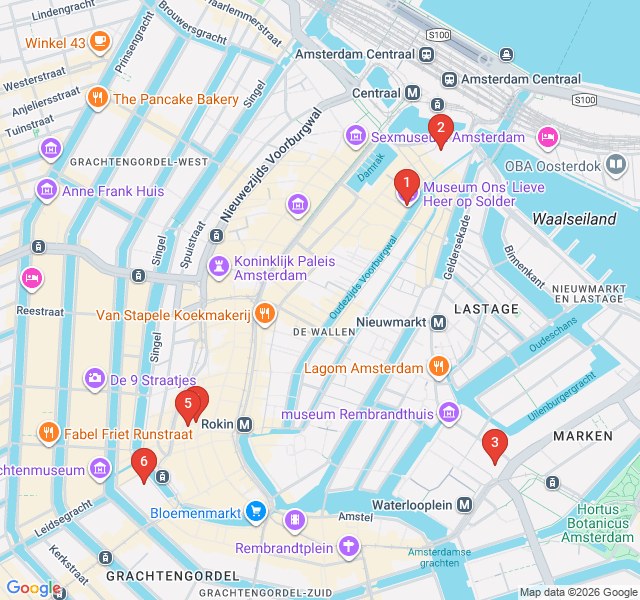
Numbers indicate the order of stops on the tour.
Start exploring with Zigway at this unassuming canal house. From the outside, it looks like any other merchant's home from the Dutch Golden Age, but the top three floors contain a fully preserved 17th-century Catholic church. After the Alteration of 1578, when Amsterdam became officially Protestant, Catholics were forbidden from celebrating Mass in public. Jan Hartman, a wealthy merchant, bypassed this by building this 'schuilkerk' or hidden church in his attic in 1663. As you walk through the narrow hallways and steep stairs, you transition from a domestic home into a pink-marbled sanctuary that could hold 150 worshippers. It stands as a powerful monument to the Dutch tradition of 'gedogen' or pragmatic tolerance.
Rising prominently across from Centraal Station, this basilica represents a turning point in Dutch religious history. Built in the 1880s, it was the first major Catholic church constructed in the city center after the ban on public Catholic worship was lifted. The architect, Adrianus Bleijs, chose a mix of Neo-Baroque and Neo-Renaissance styles, a bold departure from the Neo-Gothic trends of the time. Look up at the twin towers and the massive dome, which is decorated with stunning stained glass. Inside, the atmosphere shifts from the city's noise to a space of incense and quiet reflection, featuring a high altar dedicated to Saint Nicholas, the patron saint of sailors and the city of Amsterdam itself.
Located on the edge of the Waterlooplein, the Moses and Aaron Church occupies a site with deep roots in the clandestine era. Before this grand Neoclassical structure was built in the 1840s, two private houses—named 'Moses' and 'Aaron'—hid a secret chapel behind their facades. Even after the current church was built, the name stuck. This site is also significant for its proximity to the Jewish Quarter, symbolizing the complex religious tapestry of the city. The facade features massive Roman-style columns, and while the interior is often used for cultural events today, it remains a landmark of the Catholic emancipation in the Netherlands.
Step through the wooden door into one of Amsterdam's oldest and most peaceful spaces. The Begijnhof dates back to the 14th century and was home to the Beguines, a lay sisterhood of women who lived like nuns but took no permanent vows. Because the Beguines owned their property, they were not evicted during the Reformation, though they were forced to give up their main church. Notice the 'Houten Huys' at number 34; it is one of the only two remaining wooden houses in the city center, dating to around 1420. This courtyard is a sanctuary of silence, so please remember to keep your voice low as people still reside in these historic homes.
Situated right in the center of the Begijnhof, this church was originally the Catholic chapel of the Beguines. After 1578, it was confiscated and eventually granted to the city's English-speaking community in 1607. Interestingly, the Pilgrim Fathers, who later sailed to America, worshipped in Amsterdam before heading to Leiden, and some members of this congregation were part of that historic journey. The church features a beautiful set of pulpit panels designed by a young Piet Mondrian long before he became a pioneer of abstract art. It serves as a reminder of the international, polyglot nature of Amsterdam's religious life.
The final stop on your walking route is the Jesuit church of De Krijtberg, located on the Singel canal. Like many others, this church started as a secret house-church in the 17th century, named after the 'chalk hill' (Krijtberg) that once stood nearby. The current Neo-Gothic building, completed in 1883, is famous for its verticality and incredibly ornate interior. Unlike the austere Protestant churches nearby, De Krijtberg is a riot of color, with vibrant frescoes, gilded altars, and intricate carvings that draw the eye upward. It remains an active parish and a stunning example of how the 'hidden' faith of the Golden Age eventually reclaimed its place in the Amsterdam skyline.
Start Free on iPhone
Explore “Secret Sanctuaries: Hidden Churches and Sacred Spaces” with your very own Private Tour Guide with Zigway. Start free on iPhone, skip the large group and the fixed routes, and hear the city come alive as you go.
Your Private Tour Guide
Don't miss the good stuff
Explore Freely
 Easy
EasyAmsterdam, Netherlands
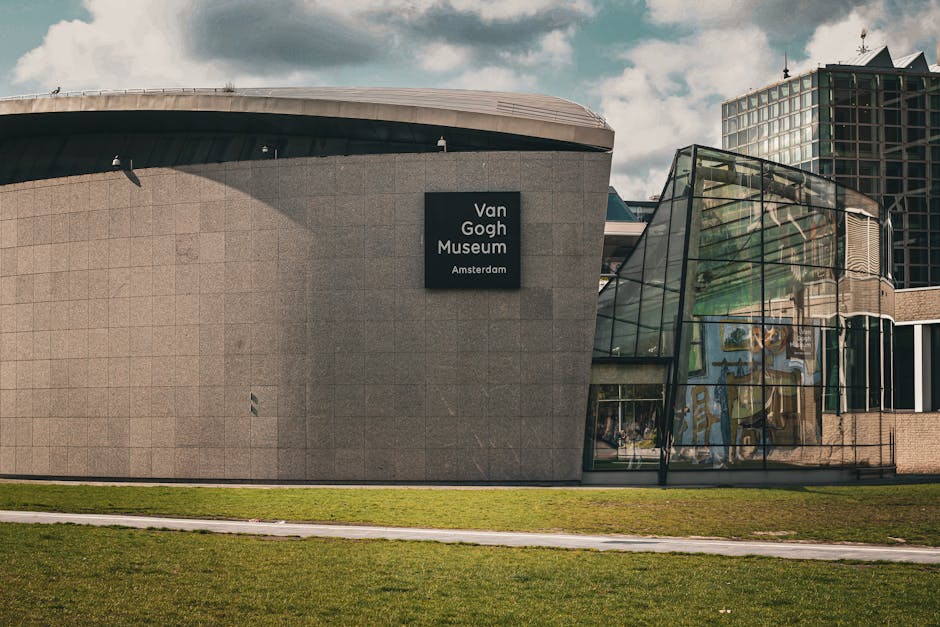
Discover Amsterdam's cultural heart on this self-guided walk from the iconic Museumplein to the serene blooming gardens of Vondelpark.
 Easy
EasyAmsterdam, Netherlands
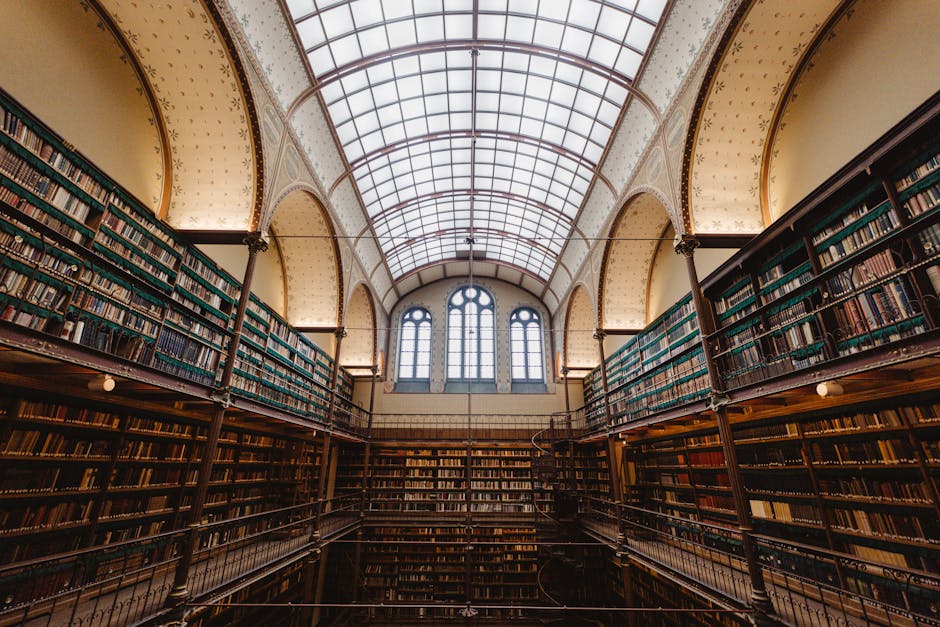
Discover Amsterdam's literary heart on this self-guided walk through historic bookshops, writers' haunts, and the homes of revolutionary thinkers.
 Easy
EasyAmsterdam, Netherlands
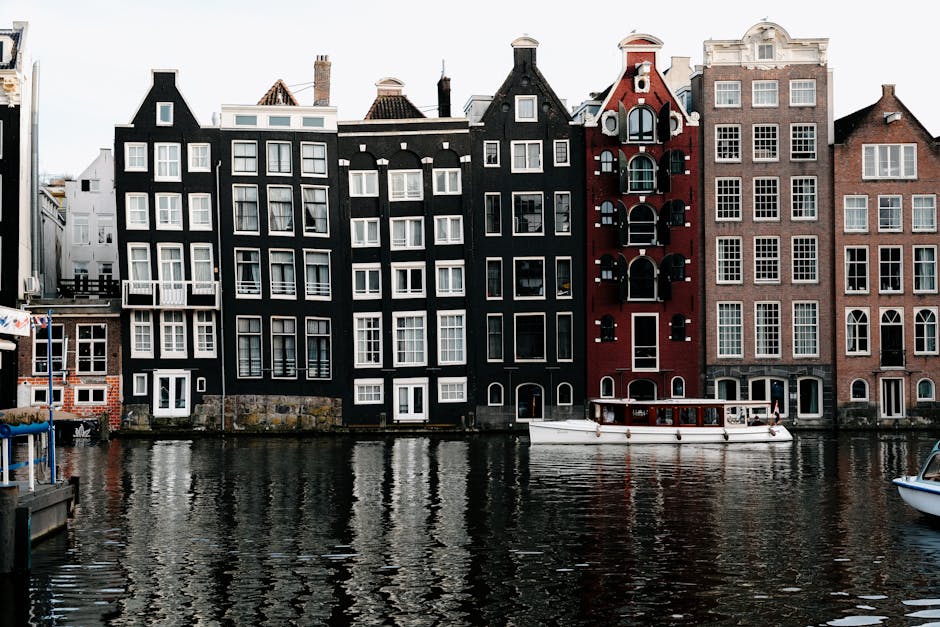
Capture the magic of Amsterdam with this self-guided photography walk across the iconic bridges and scenic banks of the Amstel River.
 Easy
EasyAmsterdam, Netherlands
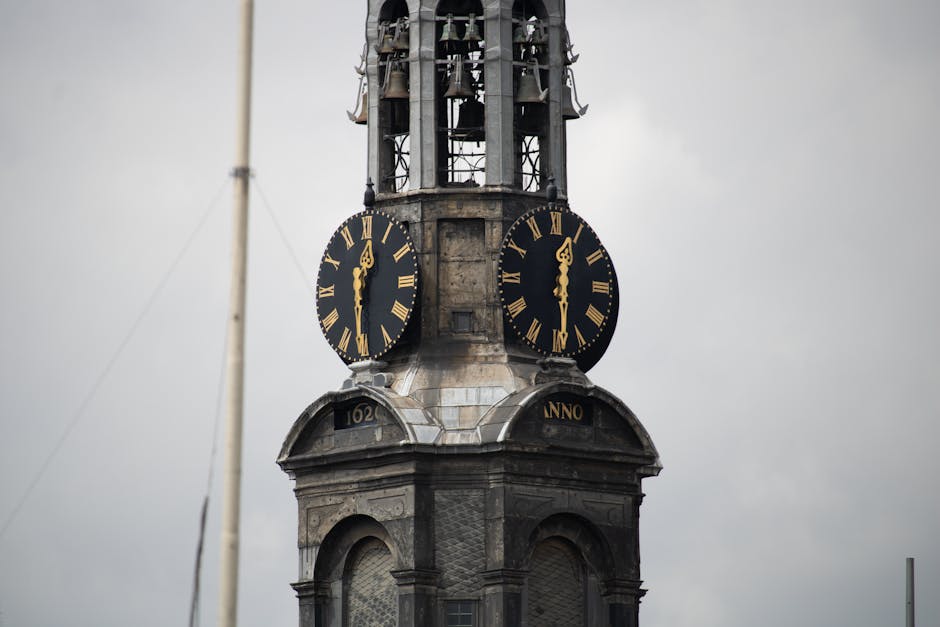
Discover the opulent 17th-century mansions and rich history of Amsterdam's famous Canal Belt on this self-guided architectural walking route.
 Easy
EasyKrakow, Poland
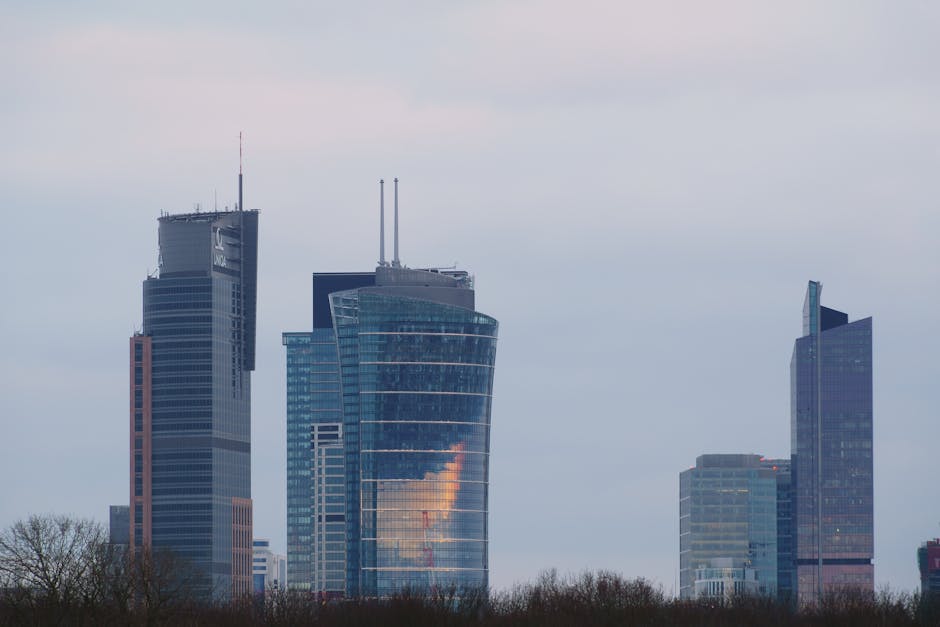
Explore the historic heart of Kazimierz on this self-guided walk through synagogues, ancient cemeteries, and vibrant squares.
 Easy
EasyWarsaw, Poland
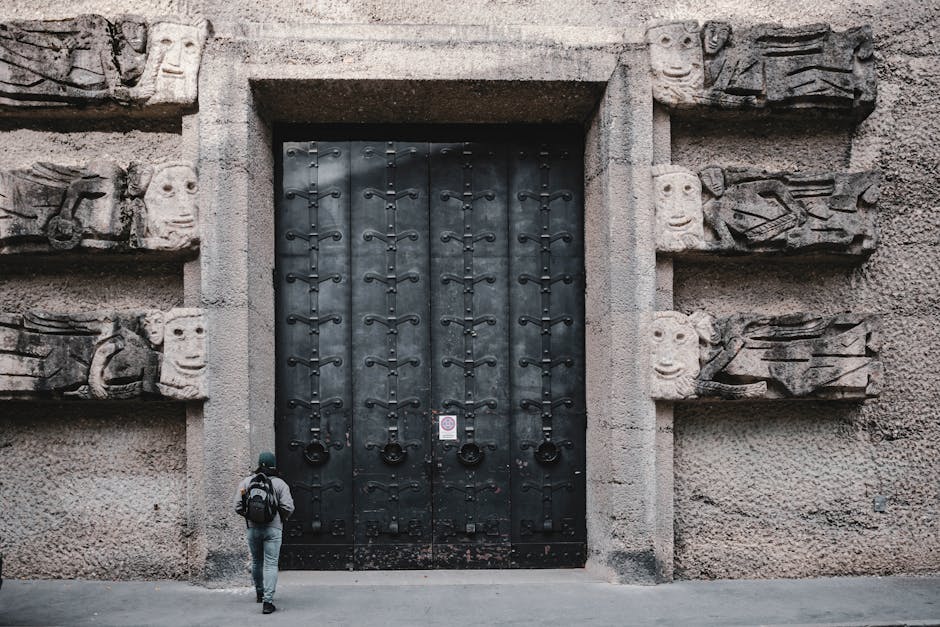
Discover the hidden courtyards and grand pre-war architecture of Warsaw's most atmospheric neighborhood on this self-guided stroll.
 Easy
EasySalzburg, Austria
Discover Salzburg's oldest medieval alley, the birthplace of the 'Silent Night' author, and breathtaking views on this quiet self-guided walk.
 Easy
EasyNairobi, Kenya
Explore Nairobi's architectural evolution from colonial-era landmarks to iconic Brutalist skyscrapers on this historic self-guided walking route.
 Easy
EasyRotterdam, Netherlands
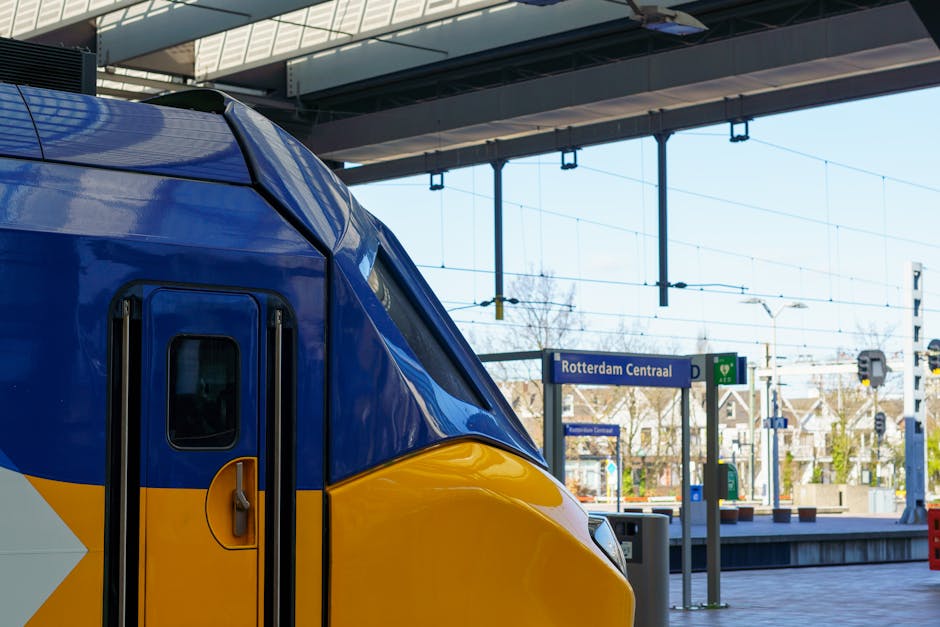
Explore Rotterdam’s cultural heart on this self-guided walk through world-class museums, modernist villas, and futuristic architectural landmarks.
 Easy
EasyRotterdam, Netherlands
Capture Rotterdam's iconic skyline and historic bridges on this scenic self-guided photography walk along the Maas River and Noordereiland.
 Moderate
Rotterdam, Netherlands
Explore Rotterdam’s lush side through secret gardens, historic harbors, and the elegant 19th-century Shipping Quarter on this self-guided walk.
 Easy
EasyRotterdam, Netherlands
Explore Rotterdam's neon-lit streets and vibrant nightlife at your own pace with this independent audio walk through the city's coolest districts.