Self-guided audio tour in New Orleans
Now a Guided Walk in the Zigway app
Firemen, Irish famine families, lodge brothers and the unclaimed: who built the cities of the dead, and why.
3.9 km · 55 min walking · 29 min of stories
The introduction and the first minute at the first stop.
Cypress Grove Cemetery
Architect Frederick Wilkinson designed it, recalling the gate of Mount Auburn Cemetery in Massachusetts. This is a firemen's cemetery.
Greenwood Cemetery and Firemen's Monument and Elks Place Tumulus
Remember the volunteer firemen at Cypress Grove? By the early 1850s their cemetery was overcrowded, so their association opened this second one.
Hurricane Katrina Memorial and Charity Hospital Cemetery
The hospital's name is still there, with the memorial's name beside it. Please speak softly here.
Masonic Cemetery No. 1
There's no canopy of trees inside, so the tombs look bigger and grander. This ground belongs to the Freemasons, a fraternal order organised in lodges.
St. Anthony of Padua Catholic Church
Later, an archbishop turned the chapel into a church for Italian newcomers. Then the archdiocese decided to close the old chapel and build a new parish church out here on Canal Street.
Guided Walk · in the Zigway app
Buy it once in the app and walk it whenever you're in New Orleans. GPS plays each story as you arrive, it works offline, and the introduction and first stop are free to try.
Start Free on iPhone
Hear the stories behind the streets and sights around you as you walk New Orleans. Try it free on iPhone.
Your Private Tour Guide
In New Orleans, the dead do not rest beneath the earth; they reside in grand architectural cities that rise above it. This self-guided walk through the Mid-City cemeteries offers a profound look into the city's unique relationship with mortality, heritage, and the high water table that necessitated above-ground burial. While many visitors flock to the French Quarter, a walking tour New Orleans enthusiasts recommend often leads to the foot of Canal Street, where a massive cluster of 'Cities of the Dead' stands as a testament to the city's diverse history. On this neighborhood stroll, you will explore a collection of distinct burial grounds, each with its own story to tell. You will encounter the Irish heritage of St. Patrick Cemetery No. 1, the grand Egyptian Revival gates of Cypress Grove, and the somber, modern reflection of the Katrina Memorial. This route is more than just a look at monuments; it is a journey through the social fabric of New Orleans. You will see how fraternal organizations, benevolent societies, and immigrant communities cared for their own in life and death. The architecture here ranges from humble wall vaults, known as 'ovens,' to the massive, ornate tumuli of the Elks Lodge. The experience concludes with a thematic extension to the Dispersed Memorial Park, bridging the gap between the 19th-century epidemics and the modern resilience of the city following Hurricane Katrina. This audio walk allows you to explore at your own pace, taking the time to read the inscriptions and appreciate the quiet beauty of these historic landscapes without the pressure of a group. It is a must-do for history buffs, architecture lovers, and anyone seeking a deeper understanding of the spiritual heart of the Crescent City.
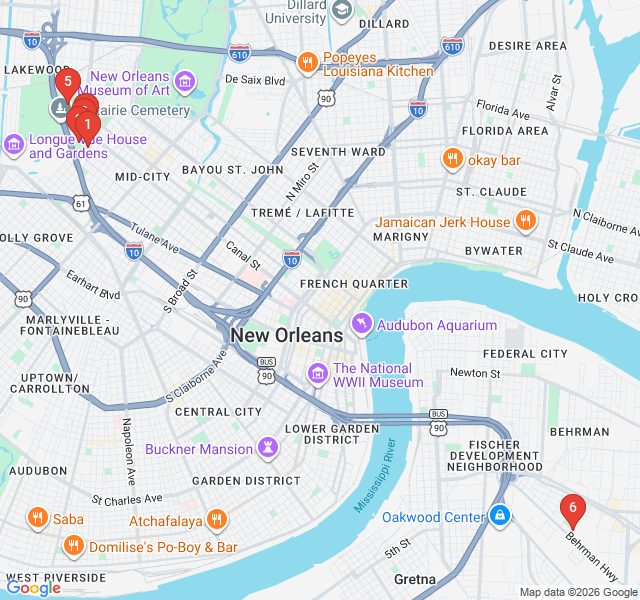
Numbers indicate the order of stops on the tour.
Established in 1841, St. Patrick Cemetery No. 1 was created primarily for the city's growing Irish Catholic population. During the mid-19th century, New Orleans was a major port of entry for Irish immigrants who often faced harsh conditions and frequent yellow fever outbreaks. This cemetery reflects that history through its dense collection of family tombs and wall vaults. As you walk through, notice the emphasis on religious iconography, particularly the Celtic crosses and statues of the Virgin Mary. The layout is typical of the 'city' style, with narrow paths resembling streets. It serves as a stark reminder of the challenges faced by immigrant communities and their dedication to maintaining their cultural and religious identities even in the face of tragedy.
Cypress Grove is often cited as one of the most architecturally significant cemeteries in the city. Founded in 1840 by the Firemen’s Charitable and Benevolent Association, it was the first cemetery in New Orleans built specifically for a volunteer organization. The entrance is impossible to miss—a massive Egyptian Revival pylon gateway that symbolizes the eternal nature of the soul. Inside, you will find grand tombs belonging to prominent families and civic leaders. The 'Firemen's Cemetery,' as it is often called, features beautiful ironwork and marble carvings. Look for the tomb of Irad Ferry, a hero of the volunteer fire department, which stands as a central focal point of the grounds.
This stop is a modern and deeply moving addition to the historic landscape. The Katrina Memorial is located on the site of the old Charity Hospital Cemetery, where many of the city's indigent and unidentified dead were buried for over a century. This specific memorial is dedicated to the victims of Hurricane Katrina in 2005, particularly the 85 individuals whose remains were never identified or claimed. The design of the memorial features winding paths that mimic the shape of a hurricane when viewed from above. It is a place of quiet reflection, honoring the lives lost during one of the city's greatest tragedies and serving as a reminder of the community's ongoing process of healing and remembrance.
Odd Fellows Rest is a fascinating example of the role fraternal organizations played in New Orleans' history. Established in 1849 by the Grand Lodge of the Independent Order of Odd Fellows, this cemetery was designed to provide a dignified burial for members of the order. The tombs here are known for their Gothic and classical influences, often featuring the 'Triple Links' symbol representing Friendship, Love, and Truth. The cemetery is walled, which was a common practice to protect the tombs from the elements and grazing animals in the 19th century. Although it is smaller than some of its neighbors, the density of history and the unique society tombs make it a vital stop on this trail.
Located just across from Cypress Grove, Greenwood Cemetery was established in 1852 and is one of the largest in the city. It was designed to accommodate a vast number of burials during a time when New Orleans was suffering from devastating yellow fever epidemics. One of the most famous sights here is the Benevolent and Protective Order of Elks tumulus, which is topped by a life-sized bronze elk standing on a grassy mound. The cemetery's vast rows of white stone tombs create a striking visual effect, truly living up to the name 'City of the Dead.' As you wander, you will see a wide variety of styles, from simple wall vaults to elaborate miniature cathedrals.
The final stop on this route, Dispersed Memorial Park, requires a transition from the Mid-City cluster to the Lower 9th Ward, representing the wider reach of the city's memorial landscape. This site commemorates those lost during the catastrophic flooding following the breach of the Industrial Canal levees in 2005. Unlike the stone cities you have just walked through, this park is a living memorial, focusing on the concepts of loss, recovery, and the 'dispersal' of a community. It serves as a contemporary bookend to the historic cemeteries, showing that while the methods of burial and remembrance have evolved, the city's commitment to honoring its past remains a central part of its identity.
Start Free on iPhone
Open Zigway as you walk and your private tour guide tells the stories behind what you pass.
Your Private Tour Guide
Don't miss the good stuff
Explore Freely
 Easy
New Orleans, United States
Explore the legendary restaurants and historic flavors of the New Orleans French Quarter on this delicious self-guided audio walk.
 Moderate
New Orleans, United States
Discover vibrant murals, iconic folk art, and industrial charm on this self-guided walking route through New Orleans' artistic Bywater district.
 Easy
New Orleans, United States
Discover the soul of New Orleans on this self-guided walk through the iconic jazz clubs and vibrant art markets of Frenchmen Street.
 Easy
New Orleans, United States
Explore the eerie history and supernatural legends of the French Quarter on this independent audio walk through New Orleans' most haunted corners.
 Easy
Krakow, Poland
Explore the prestigious Jagiellonian University district, featuring Neo-Gothic architecture, Baroque churches, and Krakow's hidden scholarly gems.
 Moderate
Gdansk, Poland
Discover the origins of WWII in Gdansk on this self-guided walk through heroic last stands, massive museums, and strategic hilltop fortifications.
 Moderate
Warsaw, Poland
Explore the resilient spirit of Warsaw's Muranów district on this self-guided walk through the history and landmarks of the former Jewish Ghetto.
 Moderate
Vienna, Austria
Follow the footsteps of Mozart and Strauss through Vienna’s historic center on this self-guided walk through the city's rich musical history.
 Easy
Nashville, United States
Explore the 'Athens of the South' on this self-guided walk through Centennial Park, featuring the world's only full-scale Parthenon replica.
 Easy
Nashville, United States
Explore Nashville's academic heart and Art Deco gems on this self-guided walk through historic Hillsboro Village.
 Easy
Nashville, United States
Explore the heart of Nashville's music industry. Discover iconic studios and the history of the legendary Nashville Sound at your own pace.
 Easy
Nashville, United States
Explore Nashville's oldest neighborhood! Discover Victorian architecture, Civil War history, and world-class craft beer on this self-guided walk.