Self-guided audio tour in Santiago
Start Free on iPhone
Hear the stories behind the streets and sights around you as you walk Santiago. Try it free on iPhone.
Your Private Tour Guide
Museums, an art cinema and cultural centers have earned Santiago's Barrio Lastarria its name as the city's intellectual heartbeat, and they are what you find on a self-guided walk through the neighborhood. Lastarria is a pocket of European charm right in the middle of a big, busy South American capital, where neoclassical facades sit next to avant-garde cultural spaces. Unlike a standard guided tour of Santiago, the Lastarria: The Intellectual Heartbeat walk lets you take your time over a coffee or a street-side bookstall. You start at the National Museum of Fine Arts, a French-inspired showpiece that stands for Chile's late-19th-century ambitions. Then you wander the green, winding paths of Parque Forestal, designed by landscape architect Georges Dubois. Further into the cobblestone streets, the mood shifts from grand civic monuments to small artistic spaces. You'll pass Cine Arte El Biógrafo, a refuge for independent film lovers, and the historic Parroquia de la Veracruz, which has quietly watched the neighborhood change around it. The high point is the Gabriela Mistral Cultural Centre (GAM), a striking piece of modern adaptive reuse and the city's top stage for the performing arts. Gabriela Mistral, Chile's Nobel-winning poet, is a presence the whole way, and the walk ends with a tribute to her that says a lot about the country's literary soul. It's a good fit if you like history, art and urban design together. First visit or long-time resident, exploring Lastarria on your own shows you the layers that make Santiago such a distinctive capital.
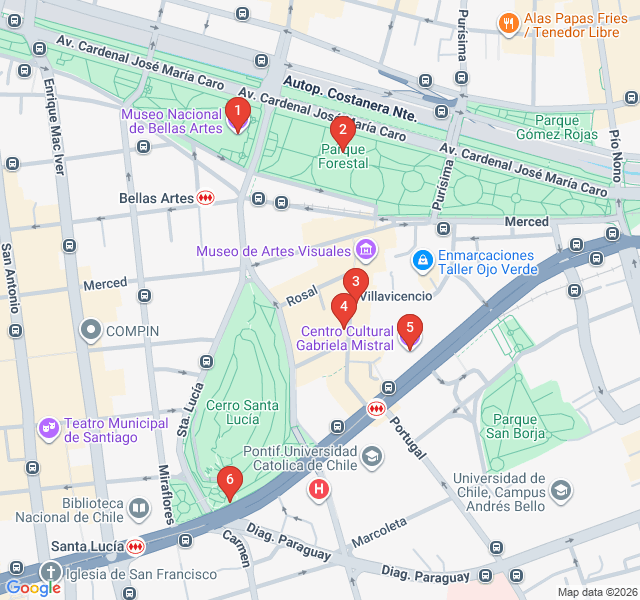
Numbers indicate the order of stops on the tour.
Begin at the Palacio de Bellas Artes, home of the National Museum of Fine Arts. Franco-Chilean architect Emile Jéquier designed it, and it opened in 1910 to celebrate Chile's centennial. It's a masterpiece of the Beaux-Arts style. Take a minute with the ornate facade, then look at the magnificent glass roof that floods the central hall with natural light. This was the first museum of its kind in South America, a sign that Chile wanted to be seen as Europe's cultural equal. Standing here, you're at the gateway to the artistic district, where the formal elegance of the early 20th century starts to blend with the bohemian feel of the streets ahead.
Parque Forestal is a long, slender park running beside the Mapocho River. Landscape architect Georges Dubois designed it in the early 1900s, modeled on the grand gardens of Paris. For people who live in Lastarria it's basically the backyard, and for the city it's a social hub. Walk under the plane trees and keep an eye out for the sculptures and monuments scattered around. It's more than a park, though. It's where the city's intellectual life spills outdoors, with book fairs, street performers and weekend markets that are a big part of the local lifestyle. On a sunny day you may not want to leave.
Down a charming side street is Cine Arte El Biógrafo, which has anchored the neighborhood's intellectual life since the 1980s. In the age of giant multiplexes, El Biógrafo sticks to independent, European and author-driven films. That it's still here says a lot about a neighborhood that won't give in to purely commercial interests. The small, intimate theater and the cafe next door are favorite hangouts for local artists and students. Not catching a film? The modest, classic entrance is still worth a look. It sums up the understated elegance and cultural depth that make Barrio Lastarria such a distinctive corner of Santiago.
Next is the Parroquia de la Veracruz, a small but significant church built between 1852 and 1855. It's neoclassical, painted a distinctive reddish-pink, with a simple triangular pediment, and it looks plain next to the fancier buildings nearby. The land it sits on was donated by the family of the Spanish conqueror Pedro de Valdivia, which ties this modern neighborhood back to Chile's colonial past. It was declared a National Monument in 1983. Among all the cafes and galleries, it gives you a quiet moment of reflection, and a reminder that there's a lot of history sitting under the neighborhood's trendy surface.
Few buildings in Chile have a history like the Gabriela Mistral Cultural Centre, or GAM. It was first built in 1972, in just 275 days, to host a major UN conference. Later it became the headquarters of the military government. After a devastating fire in 2006, it was rethought and reopened in 2010 as a huge public space for the arts. Notice the bold use of weathered steel and glass. The GAM is the center of Santiago's contemporary culture, with open plazas where young people gather to practice dance, and world-class theaters for music and drama. It stands for the city's resilience and its belief that art should be open to everyone. Spend some time on the plazas.
The walk ends at this tribute to Gabriela Mistral, the first Latin American author to win the Nobel Prize in Literature. The site, with its large-scale mural or monolith, shows how much the city respects its 'Pedagogue and Poet'. Mistral wrote often about childhood, motherhood and the landscape of Chile, and her legacy runs all through Lastarria. Standing here, you're right where the historic neighborhood meets the modern city. It's a fitting last reminder of why this area is called the intellectual heartbeat of Santiago, a place where the written word and the visual arts are treated as an everyday part of life.
Explore Mode
Open Zigway, start Explore Mode and just walk. Your guide notices where you are and tells you the story of what's around you, on this route or any street you turn into.
Start Free on iPhone
Open Zigway as you walk and your private tour guide tells the stories behind what you pass.
Your Private Tour Guide
Don't miss the good stuff
Explore Freely
 Easy
Santiago, Chile
Explore the opulent mansions and grand architecture of Santiago’s Belle Époque on this self-guided stroll through the historic Barrio Dieciocho.
 Moderate
Santiago, Chile
Explore Santiago's historic heart independently, from the colonial Plaza de Armas to the iconic La Moneda Palace.
 Easy
Santiago, Chile
Explore Santiago's 'Sanhattan' on a self-guided walk featuring South America's tallest skyscrapers and modern art.
 Easy
Santiago, Chile
Explore Santiago’s most exclusive neighborhood on this self-guided walk featuring luxury boutiques, modern art, and world-class gastronomy.
 Easy
Nairobi, Kenya
Discover Nairobi’s literary soul on this self-guided walk through historic libraries, iconic bookshops, and cultural centers in the heart of the CBD.
 Easy
Krakow, Poland
Explore the prestigious Jagiellonian University district, featuring Neo-Gothic architecture, Baroque churches, and Krakow's hidden scholarly gems.
 Easy
Gothenburg, Sweden
Explore Gothenburg's elegant academic district, featuring grand 19th-century stone architecture and the iconic cultural hub of Götaplatsen.
 Easy
Gothenburg, Sweden
Explore Gothenburg's maritime soul on this self-guided walk from historic shipyards to sleek modern piers and iconic industrial landmarks.
 Moderate
Valparaiso, Chile
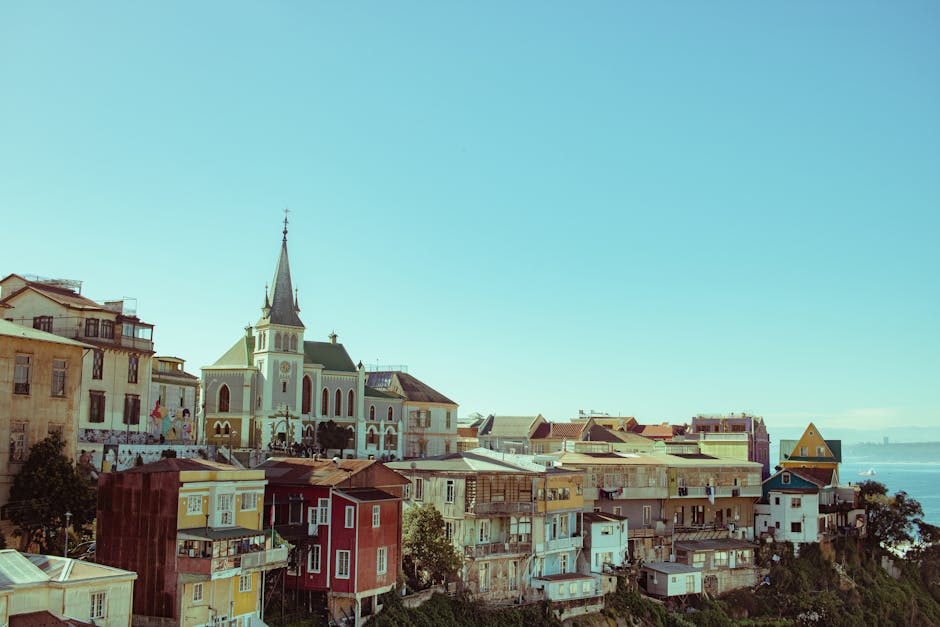
Explore Valparaíso’s iconic funiculars and stunning clifftop vistas on this self-guided audio walk through the 'Vertical City.'
 Easy
Valparaiso, Chile
Taste the heart of Valparaiso on this self-guided stroll through historic markets, legendary bars, and the birthplace of the famous Chorrillana.
 Challenging
Valparaiso, Chile
Discover Valparaiso’s vertical magic on this self-guided walk through the hidden stairways and vibrant street art of Cerro Alegre.
 Moderate
Valparaiso, Chile
Discover the vibrant street art and historic charm of Valparaiso's Cerro Alegre and Concepción on this self-guided neighborhood stroll.