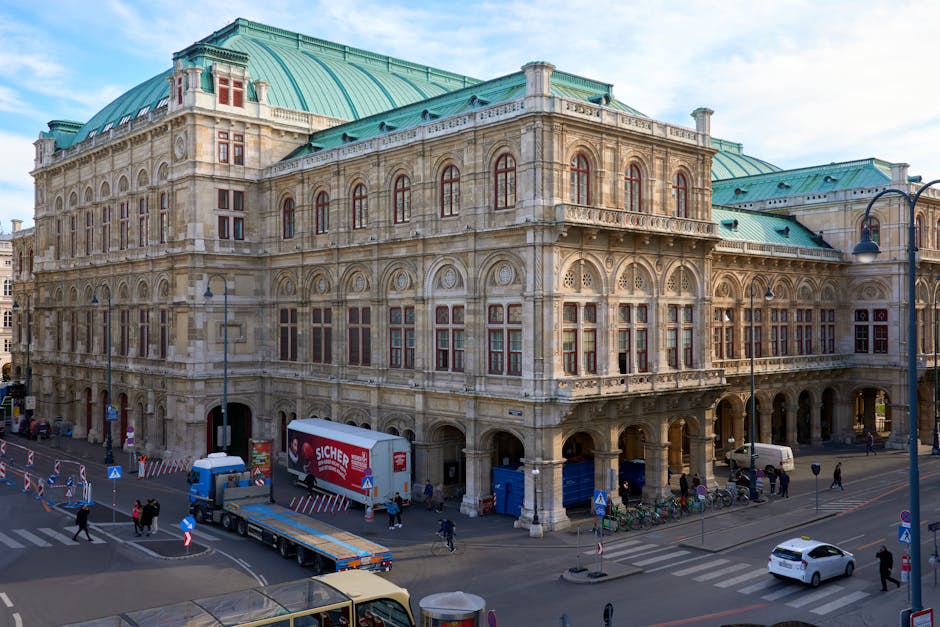
Self-guided audio tour in Vienna
Start Free on iPhone
Start free on iPhone to unlock this self-guided walking tour in Vienna. Hear all the stories that make it amazing, walk at your own pace, and begin whenever you want.
Your Private Tour Guide
At the turn of the 20th century, Vienna was the epicenter of a radical artistic revolution. This self-guided walk explores the 'Fin de Siècle' spirit, focusing on the visionary work of Otto Wagner and the Secessionist movement. As you navigate the streets of Mariahilf and the Karlsplatz area, you will witness the moment architecture broke free from the heavy, imperial styles of the past to embrace the floral elegance and functional honesty of Art Nouveau, or Jugendstil. This walking route is a curated journey through the 'Golden Age' of Viennese design, where every gold leaf and ceramic tile tells a story of rebellion against tradition. Starting at the iconic Karlsplatz, you will see how Wagner transformed functional transit buildings into works of art. The route then leads you to the Secession Building, the movement's radical headquarters, before strolling through the vibrant Naschmarkt. The architectural climax of this neighborhood stroll is the Linke Wienzeile, home to the famous Majolikahaus, where Wagner proved that modern materials could be both practical and breathtakingly beautiful. Finally, you will find yourself at a historic café that captures the authentic atmosphere of 1900s Vienna. This is more than just a walking tour Vienna offers; it is a deep dive into the mind of a man who believed that 'something unpractical cannot be beautiful.' Whether you are an architecture enthusiast or a casual traveler, this walking route provides a flexible way to explore the city's aesthetic heritage at your own pace. By choosing this independent audio walk, you bypass the crowds and focus on the intricate details—the gilded sunflowers, the medallion faces, and the ironwork—that make Vienna's Art Nouveau so unique. This walking tour Vienna highlights allows you to experience the transition from the 19th-century Ringstrasse style to the birth of modernism, all while enjoying the local flavor of the city's most famous market and residential districts.
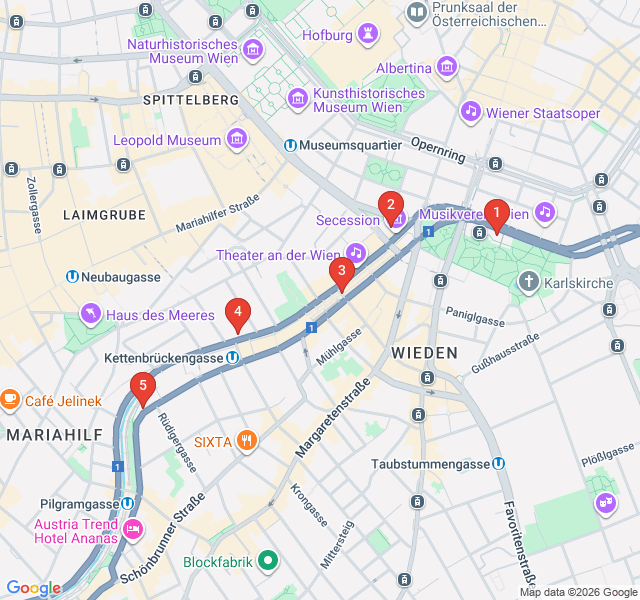
Numbers indicate the order of stops on the tour.
Begin your exploration at one of the twin pavilions on Karlsplatz. Designed by Otto Wagner in 1898, these were originally entrances to the city’s steam-powered railway, the Stadtbahn. Look closely at the structure: it is a perfect example of Wagner's early Secessionist style. The white marble slabs are held in place by green-painted iron bolts, showing his belief that structural elements should be visible and decorative. The gold-leaf sunflowers and delicate ornamentation represent a bridge between the old imperial style and the new modern age. While one pavilion is now a museum dedicated to Wagner, the other serves as a café, both standing as monuments to a man who revolutionized urban transit with high-end art.
A short walk away stands the Secession building, topped with its famous 'Golden Cabbage'—a dome made of 3,000 gilded laurel leaves. Built in 1897 by Joseph Maria Olbrich, a student of Wagner, this was the headquarters for a group of rebel artists, including Gustav Klimt, who resigned from the conservative Association of Austrian Artists. Above the entrance, you can read their motto: 'To every age its art, to every art its freedom.' The building itself was a shock to the public at the time, stripped of traditional statues and covered in stylized owls and Gorgon heads. It remains a temple to modernism and the spiritual home of the Viennese Art Nouveau movement.
As you walk toward the residential buildings, you pass through the Naschmarkt, Vienna's most famous open-air market. While it is known today for its exotic spices and local cheeses, its location is architecturally significant. Otto Wagner originally planned to cover the entire Wien River with a grand boulevard, and the market exists on the 'roof' of the river's vaulting. As you stroll through the stalls, look at the ironwork of the nearby bridges and subway entrances; these were all part of Wagner’s unified design for the city. The market provides a sensory bridge between the monumental Secession and the private residential masterpieces that lie just ahead.
Stand across the street from Linke Wienzeile 40 to take in the Majolikahaus. Built in 1898, this is perhaps Wagner’s most famous residential design. The entire facade is covered in weather-resistant ceramic tiles (majolica) painted with flowing pink roses and green vines. Wagner chose this material because it was easy to clean and durable—a marriage of beauty and hygiene. Next door at number 38 is the 'Medallion House,' decorated with gilded stucco faces by Kolo Moser. These buildings were intended to be modern apartments for the new middle class, showcasing that Art Nouveau wasn't just for museums, but for everyday living in a growing metropolis.
Conclude your walk at Café Rüdigerhof, a stunning example of Jugendstil architecture from 1902. Designed by Oskar Marmorek, the building features distinctive mask-like ornaments and elegant iron balconies. Unlike the restored pavilions at Karlsplatz, the Rüdigerhof feels lived-in and authentic. It has been a meeting place for artists and intellectuals for over a century. Step inside or enjoy the terrace to experience the lingering atmosphere of the Golden Age. It is the perfect spot to reflect on how Otto Wagner’s vision of functional, beautiful urban design continues to define the character of Vienna’s neighborhoods today.
Start Free on iPhone
Explore “The Golden Age: Otto Wagner and Art Nouveau Architecture” with your very own Private Tour Guide with Zigway. Start free on iPhone, skip the large group and the fixed routes, and hear the city come alive as you go.
Your Private Tour Guide
Don't miss the good stuff
Explore Freely
 Easy
EasyVienna, Austria
Explore Vienna’s vibrant open-air gallery along the Danube Canal on this self-guided street art and nightlife stroll through Leopoldstadt.
 Moderate
Vienna, Austria
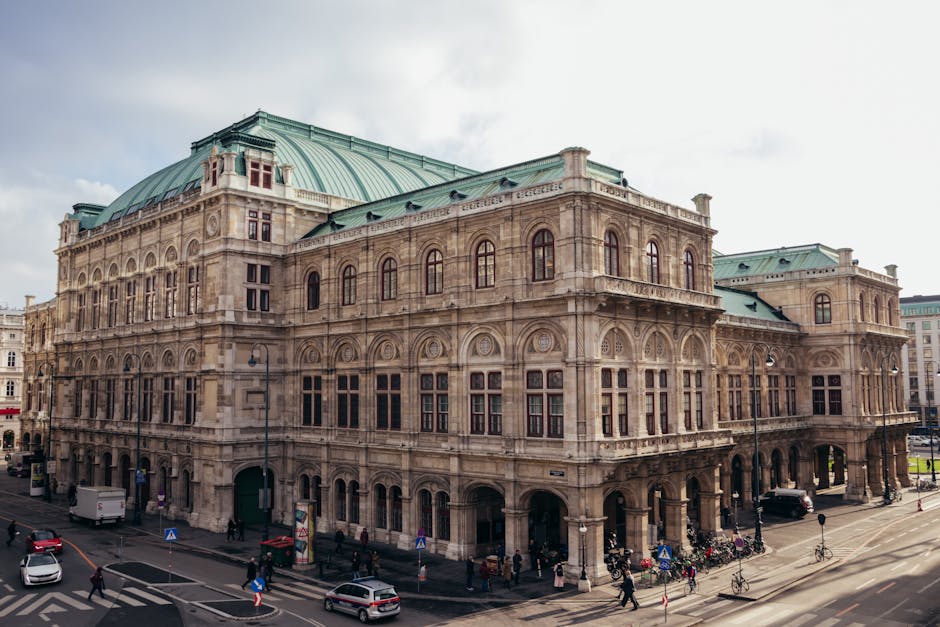
Follow the footsteps of Mozart and Strauss through Vienna’s historic center on this self-guided walk through the city's rich musical history.
 Moderate
Vienna, Austria
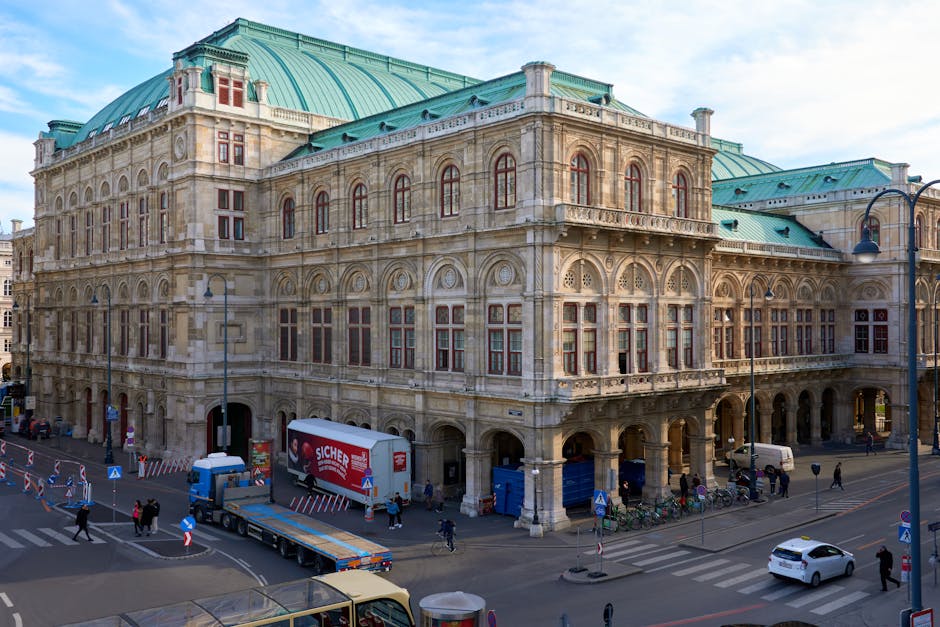
Discover the noir world of The Third Man and Cold War Vienna on this atmospheric self-guided audio walk through the historic Innere Stadt.
 Easy
EasyVienna, Austria
Discover the literary haunts and architectural gems of Vienna's legendary coffee culture on this self-guided stroll through the historic city center.
 Easy
EasyNairobi, Kenya
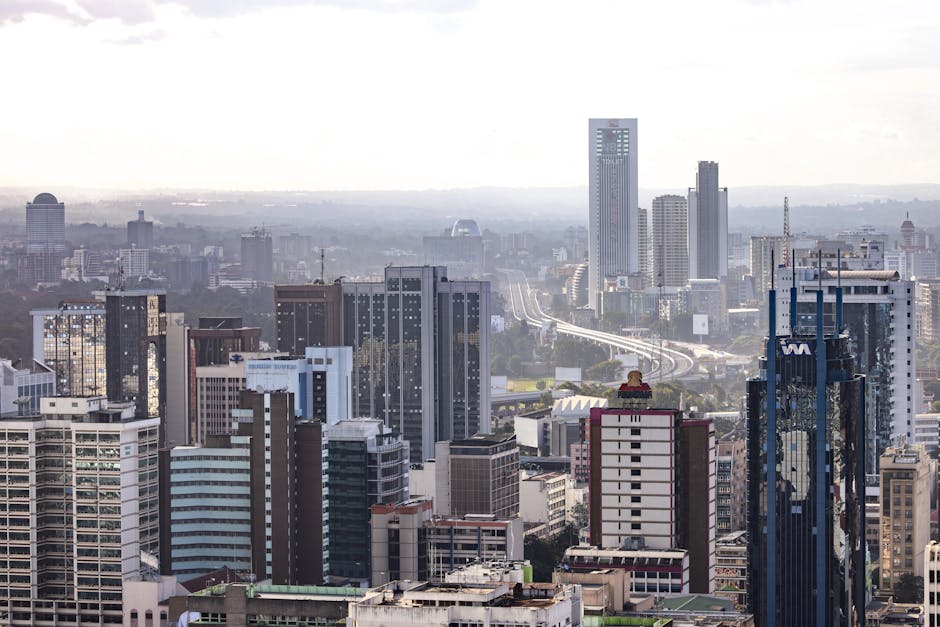
Discover Nairobi's iconic skyline on this self-guided architecture walk through the CBD’s most famous modernist and Brutalist landmarks.
 Easy
EasyNairobi, Kenya
Explore Nairobi's architectural evolution from colonial-era landmarks to iconic Brutalist skyscrapers on this historic self-guided walking route.
 Easy
EasyKrakow, Poland
Explore the prestigious Jagiellonian University district, featuring Neo-Gothic architecture, Baroque churches, and Krakow's hidden scholarly gems.
 Easy
EasyKrakow, Poland
Explore the historic heart of Kazimierz on this self-guided walk through synagogues, ancient cemeteries, and vibrant squares.
 Easy
EasySalzburg, Austria
Discover the 'Rome of the North' on this self-guided walk through the Baroque squares and monumental legacy of Salzburg’s Prince-Archbishops.
 Easy
EasySalzburg, Austria
Discover Salzburg's oldest medieval alley, the birthplace of the 'Silent Night' author, and breathtaking views on this quiet self-guided walk.
 Easy
EasySalzburg, Austria
Walk through the iconic filming locations of The Sound of Music and discover the real history of the von Trapp family in Salzburg.
 Challenging
Salzburg, Austria
Scale the heights of Salzburg on this self-guided walk to the Hohensalzburg Fortress, exploring medieval walls and ancient monastic grounds.