Self-guided audio tour in Boston
Start Free on iPhone
Start free on iPhone to unlock this self-guided walking tour in Boston. Hear all the stories that make it amazing, walk at your own pace, and begin whenever you want.
Your Private Tour Guide
Step away from the typical tourist paths and immerse yourself in the profound history of Boston's Beacon Hill. While many visitors flock to this neighborhood for its picturesque gas lamps and Federal-style row houses, this self-guided walk reveals a deeper narrative of resistance and resilience. The Black Heritage Trail focuses on the north slope of the hill, which served as a vibrant center for the city's Black community during the 19th century and played a pivotal role in the abolitionist movement. This neighborhood stroll offers an intimate look at the homes, schools, and churches of those who fought tirelessly for freedom and equality. Your journey begins at the edge of the Boston Common with a monument dedicated to the 54th Massachusetts Regiment, the first all-Black volunteer unit in the Union Army. From there, you will climb the historic streets to discover landmarks like the African Meeting House, the oldest standing Black church building in the United States. You will also encounter the Lewis and Harriet Hayden House, a critical station on the Underground Railroad where fugitives found safety. This walking route highlights the intersection of education, faith, and activism, showcasing how local residents challenged the status quo long before the modern civil rights movement. Exploring this history independently allows you to reflect on the stories of individuals like Frederick Douglass and William Lloyd Garrison, who once walked these very bricks. This is more than just a walking tour Boston history enthusiasts will appreciate; it is a tribute to the architects of American liberty. As you navigate the moderate incline of Beacon Hill at your own pace, you will find hidden gems that are often overlooked in standard city guides. Whether you are a student of history or a traveler seeking a more meaningful connection to the city, this audio walk provides a comprehensive and moving experience through one of America's most significant historical landscapes.
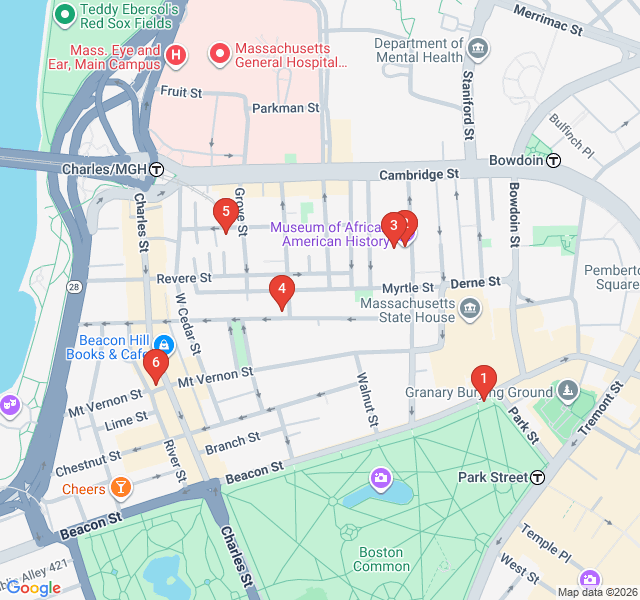
Numbers indicate the order of stops on the tour.
Start your journey at this bronze relief by Augustus Saint-Gaudens, located across from the Massachusetts State House. This memorial honors the 54th Massachusetts Volunteer Infantry, the first regiment of Black soldiers raised in the North during the Civil War. Led by Colonel Robert Gould Shaw, these men fought not only for the Union but for their own liberation and the end of slavery. Take a moment to look at the individual faces of the soldiers; the artist spent years modeling them after real men to capture their dignity and determination. This monument serves as a powerful introduction to the themes of bravery and civil rights that define this walking route.
Built in 1835, the Abiel Smith School was the first building in the United States constructed specifically to house a Black public school. At a time when Boston's schools were segregated, this institution became a flashpoint for the struggle for educational equality. Parents in the community eventually organized a boycott, leading to the 1855 legislation that prohibited school segregation in Massachusetts—the first such law in the nation. Today, the building houses the Museum of African American History, serving as a reminder that the fight for equal access to education has roots that go back nearly two centuries in this very neighborhood.
Adjacent to the school stands the African Meeting House, completed in 1806. Known in its time as the 'Black Faneuil Hall,' this building was the center of religious, social, and political life for Beacon Hill's Black residents. It was here that the New England Anti-Slavery Society was founded in 1832, and where luminaries like Frederick Douglass and Maria Stewart delivered stirring orations. The structure itself was built almost entirely by Black craftsmen. As you stand before its brick facade, imagine the secret meetings and public rallies that took place within these walls, fueling the abolitionist movement that eventually changed the course of American history.
The Phillips School represents a major milestone in the history of integration. Originally a school for white children, it became one of Boston’s first integrated schools in 1855 following the successful legal battles fought by the local Black community. This transition marked a significant victory for activists like Benjamin Roberts, who had sued the city years earlier after his daughter was denied entry to a closer, white-only school. The building’s presence in this elite neighborhood reflects the shifting social landscape of mid-19th century Boston and the persistent efforts of residents to ensure that the promise of 'liberty and justice for all' applied to every child.
This modest brick house was once one of the most active stations on the Underground Railroad. Lewis and Harriet Hayden were themselves former slaves who escaped from Kentucky and dedicated their lives to helping others reach freedom. Their home was a sanctuary for many, including the famous fugitives Ellen and William Craft. Lewis Hayden was known for his fierce protection of his guests; he reportedly kept kegs of gunpowder under the front porch, threatening to blow up the house rather than let bounty hunters enter. The Hayden House stands as a testament to the literal life-and-death stakes of the abolitionist movement in Boston.
The final stop on this self-guided adventure is the Charles Street Meeting House. Built in 1807 for a white Baptist congregation, it eventually became home to the African Methodist Episcopal Church in 1876. This site is significant for its role in challenging segregation within the church itself. Abolitionist Timothy Gilbert was famously expelled from the original Baptist congregation for inviting Black friends to sit in his pew, leading him to help found a new, integrated church. Today, the building is used for commercial and residential purposes, but its towering steeple remains a landmark of the religious and social evolution of Beacon Hill.
Start Free on iPhone
Explore “The Black Heritage Trail of Beacon Hill” with your very own Private Tour Guide with Zigway. Start free on iPhone, skip the large group and the fixed routes, and hear the city come alive as you go.
Your Private Tour Guide
Don't miss the good stuff
Explore Freely
 Easy
EasyBoston, United States
Discover colonial history and stunning harbor views on this scenic self-guided stroll through Boston's historic wharves and waterfront parks.
 Easy
EasyBoston, United States
Discover Victorian architecture, jazz history, and the vibrant SoWa arts district on this self-guided walk through Boston's historic South End.
 Easy
EasyBoston, United States
Explore Boston’s most modern neighborhood on this self-guided walk through the Seaport’s innovative architecture and vibrant art scene.
 Moderate
Boston, United States
Discover the birth of American liberty on this self-guided audio walk through Boston’s iconic historic sites and revolutionary landmarks.
 Moderate
Vienna, Austria
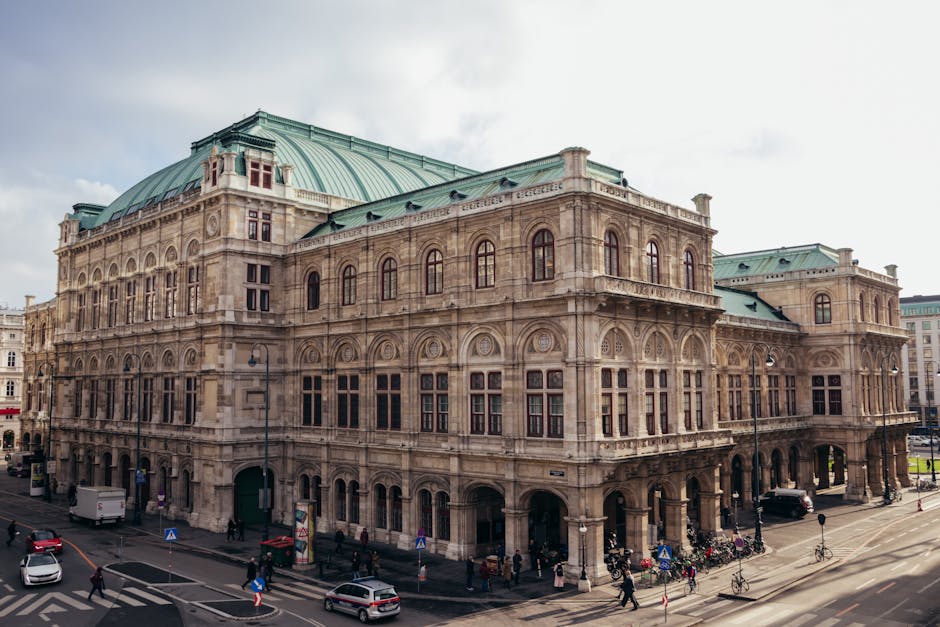
Discover the noir world of The Third Man and Cold War Vienna on this atmospheric self-guided audio walk through the historic Innere Stadt.
 Easy
EasyKrakow, Poland
Explore the prestigious Jagiellonian University district, featuring Neo-Gothic architecture, Baroque churches, and Krakow's hidden scholarly gems.
 Moderate
Gdansk, Poland
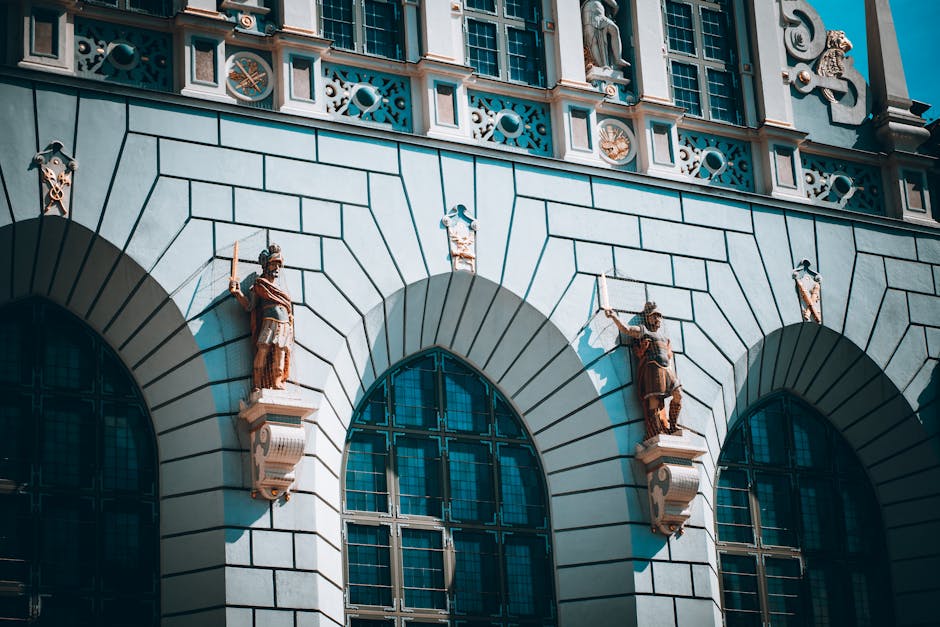
Discover the origins of WWII in Gdansk on this self-guided walk through heroic last stands, massive museums, and strategic hilltop fortifications.
 Easy
EasyGothenburg, Sweden
Explore Gothenburg’s historic wooden houses, legendary giant cinnamon buns, and panoramic fortress views on this self-guided neighborhood stroll.
 Easy
EasyNashville, United States
Explore the 'Athens of the South' on this self-guided walk through Centennial Park, featuring the world's only full-scale Parthenon replica.
 Easy
EasyNashville, United States
Explore Nashville's academic heart and Art Deco gems on this self-guided walk through historic Hillsboro Village.
 Easy
EasyNashville, United States
Explore the heart of Nashville's music industry. Discover iconic studios and the history of the legendary Nashville Sound at your own pace.
 Easy
EasyNashville, United States
Explore Nashville's oldest neighborhood! Discover Victorian architecture, Civil War history, and world-class craft beer on this self-guided walk.