Self-guided audio tour in Cairo
Start Free on iPhone
Start free on iPhone to unlock this self-guided walking tour in Cairo. Hear all the stories that make it amazing, walk at your own pace, and begin whenever you want.
Your Private Tour Guide
Step into the medieval heart of Islamic Cairo with this self-guided walk through Darb al-Ahmar, a neighborhood where the stones speak of sultans, scholars, and master craftsmen. This journey takes you off the beaten path to explore the architectural zenith of the Mamluk Sultanate, a period when Cairo was the undisputed cultural capital of the Islamic world. Unlike the crowded thoroughfares of Al-Muizz Street, Darb al-Ahmar offers a more intimate look at local life intertwined with 700-year-old monuments. On this neighborhood stroll, you will encounter soaring minarets, intricate stone carvings, and the famous 'Blue Mosque' of Cairo. This walking route is designed for those who want to experience the raw, authentic pulse of the city. You will start at the recently restored Mosque of Amir al-Maridani, a masterpiece of the 14th century, before winding through narrow alleys toward the massive fortifications of Bab El-Wazir. Along the way, you will discover how these structures served not just as places of worship, but as schools, hospitals, and community hubs. The path climbs toward the Citadel, offering a physical sense of the city's defensive history. One of the highlights of this independent travel experience is the Aqsunqur Mosque, known for its stunning indigo-hued tiling that rivals the famous mosques of Istanbul. You will also explore the funerary complex of Amir Khayrbak, a site that tells a dramatic tale of political intrigue and transition between empires. The route concludes with a refreshing contrast, leading you to the lush greenery of Al-Azhar Park, where the ancient Ayyubid wall meets modern landscape design. For those seeking a deeper connection to Cairo's soul, this walking tour Cairo provides a rare glimpse into the 'City of a Thousand Minarets' without the typical tourist bustle. Please note that this is a challenging route due to the uneven terrain and the climb toward the park, but the rewards for the curious traveler are unparalleled.
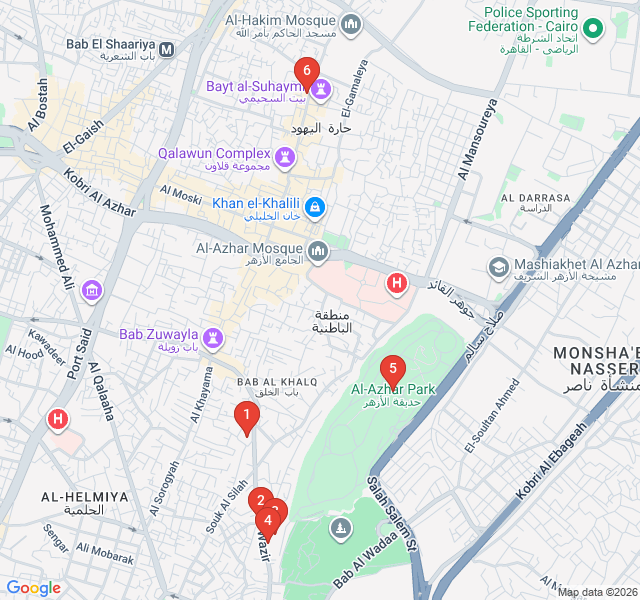
Numbers indicate the order of stops on the tour.
Welcome to the start of your journey. Built in 1339 by the son-in-law of Sultan al-Nasir Muhammad, this mosque is a prime example of Bahri Mamluk architecture. As you stand in the courtyard, look for the magnificent wooden mashrabiya screen—one of the largest and oldest of its kind in Cairo. The mosque recently underwent a massive restoration, bringing back the vibrant colors of its marble mosaics and the intricate details of its ceiling. It’s a peaceful place that sets the tone for the spiritual and architectural wonders of Darb al-Ahmar. Notice the octagonal minaret, a signature style of the era that influenced Cairene skyline for centuries.
Walking further into the neighborhood, you encounter Bab El-Wazir, or the 'Minister's Gate.' This isn't just a gate; it’s a part of the massive defensive wall built by Saladin in the 12th century to protect Cairo from the Crusaders. The gate takes its name from Najm al-Din Muhammad, a minister to the Sultan. Imagine the caravans and soldiers that once squeezed through these narrow passages. The surrounding area is a dense tapestry of history, where the residential homes of today are built directly into or against the medieval fortifications. This spot marks the transition from the commercial district into the more fortified, aristocratic quarter of the Mamluk period.
While Istanbul has its famous Blue Mosque, Cairo has its own hidden gem. Originally built in 1347 by Amir Aqsunqur, the mosque was heavily renovated in the 1650s by Ibrahim Agha Mustahfizan. It was during this Ottoman-era renovation that the interior was lined with these stunning blue and green floral tiles from Iznik and Damascus. The effect is a cool, serene atmosphere that stands in stark contrast to the dusty streets outside. Beyond the tiles, the mosque serves as a funerary complex; look for the various tombs situated within the structure, including that of the founder and several of his children. It remains one of the most photographed interiors in Islamic Cairo.
This complex is a fascinating architectural 'bridge.' Built in 1502, it belonged to Amir Khayrbak, the first Ottoman governor of Egypt—though locals remembered him as a traitor for his role in the fall of the Mamluk Sultanate. The complex is multifunctional, containing a mosque, a madrasa (school), and a sabil (water fountain). Architecturally, it is striking for its location right against the Ayyubid city wall. Look at the dome; the intricate stone carving is a hallmark of the late Mamluk style, showing incredible craftsmanship even as the empire was on the brink of collapse. The way the building navigates the sloping terrain is a testament to medieval engineering.
Take a moment to breathe in Cairo’s 'green lung.' Al-Azhar Park is a modern miracle, built over a site that served as a debris dump for 500 years. As the rubble was cleared, workers rediscovered the 12th-century Ayyubid wall, which you can see running through the park. This is the perfect spot to pause and look back over the neighborhood you just walked through. From this vantage point, you can spot the Citadel of Saladin and the countless minarets of Darb al-Ahmar. The park represents a successful blend of historic preservation and urban renewal, funded by the Aga Khan Trust for Culture to provide a space for both locals and travelers to escape the city's intensity.
Our final stop brings us to the edge of the famous Al-Muizz Street. Built in 1839 during the era of Muhammad Ali Pasha, this mosque is a beautiful example of 'Mamluk Revival' architecture mixed with Ottoman Baroque influences. Sulayman Agha was the 'sword-bearer' to the Pasha, and his mosque reflects that status. Notice the slender, pencil-shaped minaret—a distinctly Ottoman feature—contrasting with the stone carvings that mimic earlier Mamluk designs. The attached sabil-kuttab (water fountain and elementary school) is particularly ornate. It’s a fitting end to the walk, showing how Cairo’s architectural identity continued to evolve and borrow from its glorious past well into the 19th century.
Start Free on iPhone
Explore “The Forgotten Path: Mamluk Gems of Darb al-Ahmar” with your very own Private Tour Guide with Zigway. Start free on iPhone, skip the large group and the fixed routes, and hear the city come alive as you go.
Your Private Tour Guide
Don't miss the good stuff
Explore Freely
 Easy
EasyCairo, Egypt
Discover the art, architecture, and tranquil gardens of Gezira Island on this elegant self-guided neighborhood stroll through Zamalek.
 Easy
EasyCairo, Egypt
Explore the hidden heart of Egypt’s modern art scene with this self-guided walk through Downtown Cairo’s most influential independent galleries.
 Easy
EasyCairo, Egypt
Taste the heart of Egypt on this self-guided walk through Downtown Cairo’s most iconic street food spots, from Koshary towers to historic cafés.
 Easy
EasyCairo, Egypt
Explore Cairo's waterfront at sunset. From the iconic lions of Qasr El Nil to the quiet, circular streets of historic Garden City.
 Easy
EasySalzburg, Austria
Discover Salzburg's oldest medieval alley, the birthplace of the 'Silent Night' author, and breathtaking views on this quiet self-guided walk.
 Easy
EasyKrakow, Poland
Explore the prestigious Jagiellonian University district, featuring Neo-Gothic architecture, Baroque churches, and Krakow's hidden scholarly gems.
 Easy
EasyKrakow, Poland
Explore the historic heart of Kazimierz on this self-guided walk through synagogues, ancient cemeteries, and vibrant squares.
 Easy
EasySalzburg, Austria
Discover the 'Rome of the North' on this self-guided walk through the Baroque squares and monumental legacy of Salzburg’s Prince-Archbishops.