Self-guided audio tour in New Orleans
Start Free on iPhone
Start free on iPhone to unlock this self-guided walking tour in New Orleans. Hear all the stories that make it amazing, walk at your own pace, and begin whenever you want.
Your Private Tour Guide
Escape the neon lights of the French Quarter and find tranquility in the heart of Mid-City. This self-guided walking route invites you to explore New Orleans City Park, a 1,300-acre urban oasis that is as much a gallery as it is a garden. Established in 1854, this park is home to the world's largest collection of mature live oaks, some of which have stood for nearly a millennium. On this neighborhood stroll, you will witness the seamless blend of wild Louisiana nature with sophisticated man-made beauty. The journey begins at the majestic New Orleans Museum of Art, a Beaux-Arts masterpiece that serves as the city's cultural anchor. From there, the path winds through the Sydney and Walda Besthoff Sculpture Garden, where contemporary masterpieces from around the globe are nestled among lily-filled lagoons. You will also discover the park's architectural heritage, specifically the elegant Art Deco and Neo-Classical structures funded by the Works Progress Administration (WPA) during the 1930s. Landmarks like the Popp Bandstand and the iconic Peristyle offer a glimpse into the city's social history and its love for public gathering spaces. No exploration of City Park is complete without a sensory experience. This walking route guides you past the legendary Café Du Monde, where the scent of chicory coffee and powdered sugar fills the air, and leads you to the mystical Singing Oak. Throughout this walking tour New Orleans reveals its quieter, more contemplative side. Whether you are an art aficionado, a photography enthusiast, or simply seeking a peaceful retreat, this route provides the perfect balance of fresh air and cultural enrichment. Discover at your own pace why this park is considered the soul of the city, all while walking beneath the moss-draped canopy of trees that have watched over New Orleans for centuries.
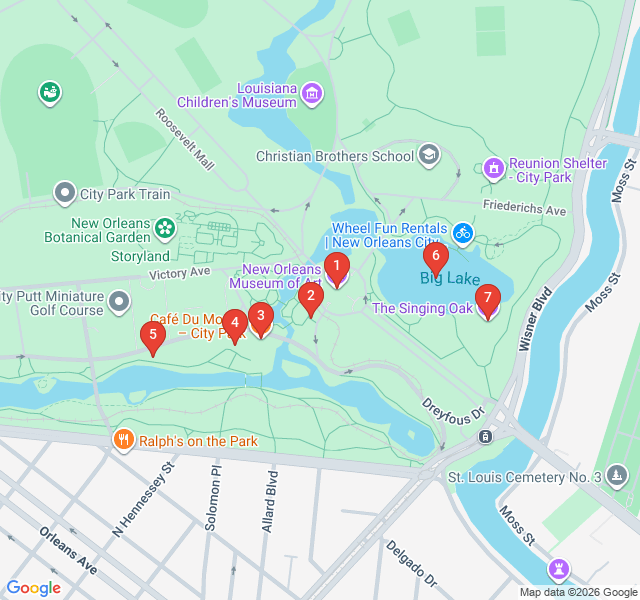
Numbers indicate the order of stops on the tour.
Begin your journey in front of the New Orleans Museum of Art, the city’s oldest fine arts institution. Opened in 1911 as the Isaac Delgado Museum of Art, this striking Beaux-Arts building was designed by Samuel Marx. Its grand columns and symmetrical facade stand as a testament to the City Beautiful movement of the early 20th century. While the interior houses thousands of works spanning centuries, the exterior itself tells a story of civic pride. Notice how the building sits at the end of Lelong Drive, acting as a majestic gateway to the park. It survived the Great Depression and multiple hurricanes, remaining a steadfast symbol of New Orleans' commitment to the arts.
Just behind the museum lies an eleven-acre sanctuary where art and environment collide. This garden is widely considered one of the finest sculpture gardens in the United States. As you walk the winding paths, you will encounter over 90 works by masters like Henry Moore and Louise Bourgeois. The garden is split into two halves: the original pine-shaded grove and the newer expansion that features a stunning contemporary bridge and water-integrated installations. Look for the way the sculptures interact with the landscape—some are hidden in the brush, while others appear to float on the lagoons. It is a free, open-air gallery that changes with the light of the day.
Housed in the historic 'Casino' building, which was never actually a gambling hall but a place for refreshments, this Café Du Monde offers a scenic alternative to the crowded French Market location. This building, with its Spanish-influenced architecture, was renovated in the late 1930s. It serves as a perfect mid-walk break. Grab an order of beignets—square pieces of fried dough buried under a mountain of powdered sugar—and a café au lait. As you sit on the patio, you are participating in a New Orleans tradition that dates back to the mid-19th century. Watch the local families and dog-walkers pass by as you enjoy one of the city's most iconic treats.
Just a short stroll from the café is the Popp Bandstand, a gift to the city from local businessman John F. Popp in 1917. This Neo-Classical structure, with its white columns and domed roof, was inspired by the Temple of Love at Versailles. For over a century, it has served as a stage for community concerts and celebrations. During the 1930s, the surrounding area was enhanced by the Works Progress Administration, which added much of the park's current infrastructure. The bandstand remains a popular spot for weddings and impromptu music, echoing the park's long-standing role as the 'people's living room.'
Walking further into the heart of the park, you will reach the Peristyle. Built in 1907, this Neo-Classical pavilion was originally designed as a platform for dancing and music. It is flanked by concrete lions that guard the entrance, overlooking the tranquil waters of the park’s lagoons. The open-air design allows the breeze to flow through the columns, making it a favorite spot for locals to escape the Louisiana heat. Notice the intricate details on the columns and the ceiling; it is a prime example of the early 20th-century architecture that gives City Park its timeless, European feel. It is one of the most photographed spots in the city for good reason.
Continue toward Big Lake, the recreational heart of the park. This area underwent a massive restoration in the early 2000s, transforming it into a hub for walking, jogging, and boating. The trail around the lake offers panoramic views of the park’s skyline and the wildlife that calls these waters home—look for swans, ducks, and the occasional turtle sunning on a log. The lake represents the park's transition from a wild swamp to a curated public space. It’s a great place to observe the scale of City Park; at 1,300 acres, it is significantly larger than New York’s Central Park.
Your walk concludes at one of the park’s most whimsical hidden gems: The Singing Oak. At first glance, it looks like any other massive, ancient live oak draped in Spanish moss. However, as you step beneath its heavy branches, you will hear a hauntingly beautiful melody. This is a sound installation by artist Jim Hart, who hung dozens of wind chimes within the tree. The chimes are all tuned to a pentatonic scale, ensuring that no matter how the wind blows, the music is always harmonious. It is a place of profound peace, where the ancient age of the tree meets a modern artistic touch, providing a perfect final moment of reflection for your journey.
Start Free on iPhone
Explore “City Park: Oaks, Art, and Art Deco” with your very own Private Tour Guide with Zigway. Start free on iPhone, skip the large group and the fixed routes, and hear the city come alive as you go.
Your Private Tour Guide
Don't miss the good stuff
Explore Freely
 Easy
EasyNew Orleans, United States
Explore the legendary restaurants and historic flavors of the New Orleans French Quarter on this delicious self-guided audio walk.
 Moderate
New Orleans, United States
Discover vibrant murals, iconic folk art, and industrial charm on this self-guided walking route through New Orleans' artistic Bywater district.
 Easy
EasyNew Orleans, United States
Discover the soul of New Orleans on this self-guided walk through the iconic jazz clubs and vibrant art markets of Frenchmen Street.
 Easy
EasyNew Orleans, United States
Explore the eerie history and supernatural legends of the French Quarter on this independent audio walk through New Orleans' most haunted corners.
 Easy
EasyGdansk, Poland
Discover the monastic heritage, world-famous organs, and lush botanical gardens of Oliwa on this peaceful self-guided neighborhood stroll.
 Easy
EasyWarsaw, Poland
Explore the 'Polish Versailles' at your own pace. Discover Baroque architecture, royal history, and stunning gardens on this self-guided walk.
 Easy
EasyWarsaw, Poland
Discover Warsaw's intellectual heart through historic campuses, peaceful parks, and the stunning rooftop gardens of the University Library.
 Moderate
Gothenburg, Sweden
Explore Gothenburg’s lush "Green Lung" on this self-guided walk through the Botanical Garden, Slottsskogen park, and rugged Änggård Mountains.
 Easy
EasyNashville, United States
Explore the 'Athens of the South' on this self-guided walk through Centennial Park, featuring the world's only full-scale Parthenon replica.
 Easy
EasyNashville, United States
Explore Nashville's academic heart and Art Deco gems on this self-guided walk through historic Hillsboro Village.
 Easy
EasyNashville, United States
Explore the heart of Nashville's music industry. Discover iconic studios and the history of the legendary Nashville Sound at your own pace.
 Easy
EasyNashville, United States
Explore Nashville's oldest neighborhood! Discover Victorian architecture, Civil War history, and world-class craft beer on this self-guided walk.